The Long Story: Part 4

Reassembling

Because so much of my identity has shifted over the past few years, I need and want a fresh start with my writing career. I’m willing to lose a boatload of reviews and ranking to achieve this, because I feel confident that dismantling and reassembling my author platform will be truer to who I am and what I write in the long run.

Part of the fresh start I’m making is changing my author name and opening a small publishing company. The publishing company will not only serve as a platform for republishing my books, but I will also take on one writer at a time to help them develop their writing in a mentor-based publishing process (more on that later).

There are tax-based reasons for republishing my books under my new company (DelSheree Press LLC), but more than anything it’s about treating my writing as a professional career and consolidating everything I do with books, writing, coaching, teaching, etc. into one space where I can represent myself and authors I work with in a professional manner.

My plan for my own books is to go back through all 34 of them, series by series to reevaluate the stories and characters for structure and craft issues, ideas and values that don’t sit right with me, relationships that need revisions, and cover art that needs updated.

Here’s a look at what I have planned (in order) and issues I know I need to work on:

  • Date Shark – relationships, representation of sex, possibly cover updates
  • Eliza Carlisle – relationships, depth of mystery, revise/expand novella, cover updates
  • What Had to Be Done – relationships
  • Torino Dreams – relationships, clarify setting
  • Memory’s Edge – relationships, clarify setting, possibly update covers
  • Handbook – relationships, humor, new covers
  • Aerling – clarify setting, fix plot issues, intentional revision of relationships, new covers
  • Some One Wicked – relationships, psychology of characters, series title change, address drop-off in readers between books 1 & 2 (?), new covers
  • Destroyer – review plot for continuity, relationships, new covers
  • Escaping Fate – relationships for sure, review plot for continuity after planning out remainder of series ideas/world concept, new covers
  • Ghost Host – rename individual books, plot continuity, relationships, realism of connection to FBI, new/revised covers
  • Life & Being – plan out series concept/world and revise as needed, relationships, cover update and series plan
  • Twin Souls – revision of setting/cultural aspects, review plot for continuity, new covers
  • Child of Destruction – build out world and revise, relationships, potentially get rid of love triangle aspect, new cover, actually publish this one and decide whether to write book 2 or wrap in one standalone book

Ideally, I would like to have this done by the end of 2026, but I know that is probably unrealistic. It will depend on how much rewriting I end up needing to do on individual books. Then there’s time to actually do all of that and funds to pay for various services I’ll need along the way.

Most likely, it will take me two years to get through all of these. Even though I look at writing much more seriously than I used to, I have many other aspects of life that also need my attention. My two children are now in college, but I have learned that adult children still need you just as much as they did when they were little. I also have three wonderful and busy step children and I try my best to be there to support them in their interests and activities as much as possible. I’m married to a wonderful man who has his own goals and interests that I want to support those however I can as well.

I teach also high school full time, host a weekly radio show called Write On Four Corners (which I love but takes quite a bit of time), coordinate a monthly lecture series called Write to Publish, and will be adding the new adventure of opening DelSheree Press in 2026. Time is at a premium for me right now, and my goal is to use it wisely to balance time with family, work, and, my writing/publishing pursuits. This has never been an easy thing for me, but I’m getting better at it the more I make balance a priority.

I am working on several fiction projects right now, but the first book I plan to publish in 2026 is a nonfiction book based on a workshop I have taught several times. I don’t have enough time to teach extra class right now, but I want to continue to help authors. This book will help me do that. The working (maybe final?) title is “Start Here: An Introduction to Indie Publishing.”

After this post, I’ll return to posting monthly-ish or when I have something interesting to share.

I’ll share more in the future about my current fiction projects, which started as one book and has split into two. That’s also a long story of reassembling a deconstructed idea.

What have you had to reassemble in your own life?
The Long Story: Part 3

Relationship Breakdown

As I mentioned in my last post, the religion I was raised in and the marriage I spent 19 years in drastically shaped my view of relationships and what they should and shouldn’t look like, as well as what should and shouldn’t be tolerated while in one. That influenced my writing by coloring how I portrayed relationships, both good and bad.

Things I thought were positive aspects, I have realized since, came off as demanding or manipulative. Certain interactions that I portrayed as negative, such as challenging a partner when views differed or standing up to someone and holding their ground, are perfectly normal parts of navigating a partnership.

While my current husband and I were dating, he read several of my books and we had multiple enlightening conversations about the relationships I wrote for my characters. It had already been several years since I’d really done any writing at that point, which I think helped me look at things more objectively. My books felt like part of my past—a part I didn’t quite know how to revive into the life I was rebuilding.

Before my divorce, my mental health had been deteriorating and I was not in a good place the last few years of my marriage. In addition to years of unhappiness and stress, several major negative experiences had shaken me profoundly. I knew I needed to make a change, but I didn’t know how and I wasn’t strong enough at that point to even see a path forward.

It took a lot for me to seek help and I felt a lot of shame and embarrassment over needing therapy. I’d always been a doer, a fixer, and get-things-done-and-dealt-with kind of person. Having to go to my doctor and then a therapist and admit that I wanted to disappear and was having suicidal ideations just about broke me.

But it also saved me.

Therapy taught me a lot about myself and what I wanted out of life for me and my kids. Seeing the negative effects my kids were experiencing was what finally pushed me to get help. I needed to gain strength to be there for them and help them heal. I learned about healthy boundaries, that it was okay to have big feelings, that there were ways to manage those big emotions when they threatened to overwhelm, and about mechanisms to cope with stress in healthier ways.

While I was learning how to manage my emotions and stress better, I slowly began to realize that the relationship I was in was not okay and was never going to change. Leaving the church had opened up the possibility that I didn’t have to stay in a bad situation forever, but developing inner strength to stand up for what I was learning was right in a relationship was what freed me to finally end things.

Because I had spent my childhood watching an unhealthy relationship between my parents, then spent five years in the middle of their never-ending divorce proceeding, and had followed their example into a similar relationship, I had no idea what a solid, respectful, healthy relationship looked like when I was writing romances.

In some ways, that probably helped me created flawed characters, but they were flawed in ways I couldn’t see at the time. Looking back at some of those stories, the endings or how characters arrived at their endings aren’t always what I would write now. Flawed characters are important, and I will keep writing them, but that works so much better when it’s intentional and not born from misguided ideas about what relationships should be.

As I go back through my old books, I will make changes where needed to be more intentional in how I craft flawed characters and how they learn and grow in order to achieve the ending they want. Having been through that process myself gives me a lot of starting points for new stories as well, and being in a wonderfully supportive and healthy relationship now guides me in helping characters find that as well (because I love a good HEA).

There will always be those who dislike romance, either because it is often too formulaic or seems trivial, but relationships (romantic or not) are a key part of being human. They can be what sustains you or what tears you down. We learn important lessons from who we put our trust in to safeguard our hearts and dreams for the future. Some of those lessons are brutal. Others teach us who we want to be and how we want to live our lives.

What relationship has had the biggest impact on you?

The Long Story: Part 2

Leaving and Learning

The first leaving I mentioned in the last post was leaving the faith community I had been raised in and had committed to raising my children in as well. Faith can be a wonderful thing that brings comfort and community, but it can also constrict and hold hostage. I experienced both sides of that and everything in between as I participated in the Mormon faith as best I could.

There were always questions, things that didn’t make sense, confusing parts that contradicted each other. I trusted that these would all be worked out later—much later, as in the afterlife. As a very young wife (18) and mother (19, then again at 21), I had a lot of other things on my mind. Trusting that religion would pull it all together someday in the future was what I could handle.

My husband, at the time, struggled much more with faith. That is his story to tell, but I will share that over time it affected me because I was desperate to do something to help him. He had spent a lot more time studying and researching than I had—which was part of the problem—but I thought that if I connected more with what he was struggling with, I could help him figure it out.

That led me down a rabbit hole that I won’t get into here, because it isn’t the point of this post and I have no desire to disrupt anyone else’s beliefs, but the end result was that I did not find the answers I was looking for and the concepts I had always struggled with before became amplified. My search also led me to question what I had believed about relationships, duty to stay in a relationship, and what it meant to be happy.

I wasn’t happy, in my faith or in my life. When it came to faith, I realized I could no longer participate because I no longer believed in its tenants, promises, or demands.

My faith had been a major factor in my decision-making my entire life up to that point. Getting married young to someone I barely knew, having kids right away, not prioritizing my education in favor of supporting my husband’s education, not believing I could have a career either at all or until my kids were grown, not challenging decisions or standing up for myself, and so on.

My mantra always seemed to be that I just had to find a way to endure and to make it work.

My writing was also affected, and not just that I shied away from certain topics because of what family or church members might think. Writing was a hobby and that was all it could ever be. It took time away from my family, kept me from keeping a cleaner house or having dinner ready on time, cost money that should have gone to the family’s needs, distracted me, etc. None of these things were actually true, but I believed them. Humans tend to do that when the message is repeated often enough.

I did the best I could to make writing into something both fulfilling and income-producing during those years. I grew a decent following. I wrote a lot and I wrote fast. Spending money on editing was not going to fly at that time, so many of my early books especially are underdeveloped and timid in their approach to tough topics. They were basically first drafts with proofreading by friends and family. These are the ones that will see some significant changes when republished, if not full rewrites.

My faith and marriage also heavily influenced my worldview, which skewed my understanding and view of relationships—what was normal and healthy and okay and what wasn’t. It took my current husband (another life change—this time for the positive) reading some of my books and kindly but directly questioning the way I had portrayed healthy or good relationships in my writing to show me how much my mindset had shifted. I’ll get more into the relationship part of that in the next post.

When your understanding of humanity and existence in general completely collapses and has to be rebuilt, you look at things differently. When I reread some of my books, I no longer connect with certain aspects of what I wrote, relationships and otherwise. Another area for revisions when I republish.

Some might ask, why bother? Why not let those previous books remain as a time capsule and move on to new projects?

I am moving on to new projects, which I’m excited about and will talk about later, but I don’t like the idea of fifteen years of my writing career (and yes, I consider it a career worth investing in fully now) being set aside because I don’t connect with them anymore. It’s really hard for me to promote something I don’t fully believe in.

I also know this will be a great learning experience for me, both as a writer and as a human. I will get to look back at what I thought and believed at different stages of my life and see how much they’ve changed. It’s encouraging, in a weird way, to know that I have grown so much and opened myself up to new ideas and new ways of seeing the world.

So, as I revise and republish, if you are curious about the changes and want to reread a book you read previously, let me know. I’ll be back at zero with reviews on most of my books and I’d be happy to send review copies for those who might want to share their honest thoughts.

What is something you’ve had to reevaluate in your life?

The Long Story: Part 1

The Long Story

It’s been a while, I know. There’s a reason (or several). But it’s a long story.

I will be spending 2026 (and probably beyond) shifting everything I’ve built over the last 15 years of publishing from DelSheree Gladden to DelSheree Spinner, even though I know this is a somewhat crazy thing to do.

Advice writers are constantly given—and which I have given to many writers as well—is to build your brand early and be consistent about maintaining it. So, why am I essentially demolishing my brand when I know it goes against advice almost everyone would probably give me?

I will attempt to explain over the next few posts. There are layers to this story, of course, two of which need to be mentioned right off the bat.

I was raised is the Mormon/LDS faith. I got engaged at 17, to someone I had only known a few months and who was 4 years older than me. I got married 6 months later at age 18. This was considered very normal in the culture I grew up in. My parents did not counsel me to get to know this person better, wait until I was older, focus on my education, etc.

I also grew up with a very manipulative and emotionally abusive mother who made it clear that she didn’t like me. Although I recognized that she treated me differently than my siblings, it was still all I knew and I thought it was normal behavior for a mother to have such obvious favorites and to pit her children against each other.

You’ve probably all heard the adage that you’re drawn to what’s familiar when it comes to relationships. I think that’s particularly true when a person believes the negative behaviors they’ve experienced are what everyone deals with as well. Add to this the belief that marriages are eternal and divorce is a sin that will likely ostracize you from your religious community.

I married someone who was very similar to my mother, and I believed I had no other option than to stay and make it work even when I started to see the signs that our relationship was not healthy. My mindset started to shift in 2015 when I made the incredibly hard decision to leave the church I had spent my whole life up to that point trying to believe and live. Leaving opened me up to redefining who I was, what a healthy relationship looked like, what I wanted for myself and my kids, and what it meant to be happy.

The next few years of learning, growing, and seeking help through therapy opened my eyes and led to another leaving. This time my marriage.

I’ll spoil the ending and say that I have no regrets and I am so happy in my life now, but two major life changes in the course of only a few years will undoubtedly come with complications, one of which was having to put writing on the back burner.

The rest of those life changes and complications I’ll talk about over the next few posts.

In the meantime, please be patient as my website and book catalog are a mishmash of Gladden/Spinner and some of my books may be temporarily unavailable or mixed up on retailers. As I begin the process of republishing, some books will stay largely the same, others will not (I’ll explain why later), and there may be shifts in how and what I write as I get back into it.

What won’t change is that I believe so much that storytelling is important. It connects us. It engenders empathy. It turns strangers into friends and supports. Even if my books and writing look a little different moving forward, my commitment to telling stories that say something true and meaningful won’t.

What do you love most about storytelling?

Moving to Substack

I have decided to combine my newsletter and blog (which I obviously haven’t had time for lately) and move over to Substack for future blogging/newsletter announcements. As I try to get back into gear with writing and book-related stuff, I’m trying to consolidate my efforts so I can be more efficient and hopefully get more done.

If you’d like to follow me on Substack for updates, you can check out my first post and subscribe.

Action Scenes: Adding Uniqueness

One of my pet peeves with action scenes, whether in film or book form, is repetitive action. I can only watch the same chase so many times or read endless thrusts and parries for so many pages. Keep action scenes interesting by making them unique.

Adding Unique Elements

Every fight, explosion, or gunshot needs to have at least some level of uniqueness to it in order to keep the various scenes from all blending together. If a reader comes to an action scene that sounds too similar to the last one, the likelihood that they will start skimming is high. Skimming a scene can lead to putting down the book all too quickly.

The Princess Bride is a great example of making every action scene unique. Granted, the writer takes that to a level of silliness that may not be appropriate for all stories, but dissecting how the scenes differ can still serve as a great lesson in how to add unique elements.

Every action scene in The Princess Bride has a unique element, whether it be odd weaponry like Count Rugen’s torture device which is not-so-uniquely (but humorously) name The Machine, unusual locations like the Fire Swamp or the eel-infested waters near Florin, interesting people who unexpectedly get involved the action like the disillusioned Miracle Max, or a surprising goal for the action such as Count Rugen not actually wanting to kill Wesley after his capture, at least not right away.

Accomplishing this level of uniqueness, in level of variety if not level of absurdity, consider all the aspects of the scene.

Setting

Use different settings for fight scenes within the book, or at least within close proximity to each other in the story. Repeating a fight scene location may be integral to the story, but other elements can be changed to make it a unique scene overall.

When considering locations for an action scene to take place, consider how different settings can create interesting challenges for the characters. For example, going into a gunfight from a stairwell presents different challenges than bursting through a window. Line of sight will be frequently obscured, it will be more difficult to catch up to the other person, and the person being chased has multiple opportunities to exit the stairwell and escape.

It may also be possible to pair the setting with specific characteristics of the participants for an added layer of uniqueness. If a character has a physical limitation, choose a setting that will play to that weakness when appropriate. The same may work for particular fears, aversions to locations, etc.

Participants

Vary the number of people involved in each action scene when possible. The main character may need to be in every scene, particularly if the story is told from that character’s point of view, but the other participants can be changed up.

This not only changes the actual faces involved in the scene, it changes what skills and abilities are brought to the action. Consider the goals of the scene to determine which sets of skills or persons will best serve that intended goal or outcome. Reading about the same skills or techniques being performed can get boring, so try to highlight different abilities in each action scene.

The number of participants also changes the flow and composition of action. A one-on-one fight will play out much differently that two groups battling, as will an unbalanced number of participants.

The type of participants involved can also make a scene more unique. Consider both physical types and skill types, whether realistic skills or fantastical skills. Size differences can have a major impact on the outcome, or the level of believeability of the outcome. David and Goliath-style action is a common trope, but it still needs to remain within the reader’s capability to suspend disbelief.

Tempo

Change the tempo of scenes that happen consecutively. The nearer they are to each other in the story, the more need there is for them to have differing tempos.

A chase scene has different pacing than a single explosion. A chase is long-lasting and the focus of the action, while an explosion is short-lived and the focus will be largely on the aftermath of the action.

Tempo can also refer to whether the main tension is an undercurrent, such as emotional tension building between two people through small actions, or direct action such as a screaming match that erupts during a meeting.

Tempo is an important consideration when building to a main action scene. Layer different tempos with a trend toward escalation when building to a large event.

Weaponry

Utilizing different weapons in action scenes helps avoid repetition of moves or actions. A spontaneous fight will use items lying around the setting, providing a very different feel than fighters trained to use particular weapons.

Even in action scenes that require specific weaponry, such as military stories using professional-level firearms, a situation may arise where the character is unable to use her normal weapon, must engage in physical combat, or is forced to improvise mid-scene.

Learning a new weapon or set of weaponry also provides opportunities for uniqueness. The same is true for fighting styles.

Goals

Create different goals for each action scene, or for scenes close together in the story timeline. A change in goals will often necessitate slight changes in the other elements of the scene. Rescuing someone requires different types of action than wantonly killing everyone in the room.

When planning scenes, aim for a variety of goals that will create a need for more unique scenes within the story. Always trying to accomplish the same goal can easily become routine and uninteresting to the reader.

As we wrap up this series on action scenes, remember that every action scene should have a purpose and move the story forward. Creating unique action scenes that reveal important information will keep a story moving and entertain readers.

Action Scenes: The Aftermath

Action scenes don’t stop when the last punch lands or the escape is made. It doesn’t matter whether the scene was verbal action or physical, there are consequences to what just happened that needs to be taken into consideration.

Pacing

Action scenes are intense, either emotionally, mentally, or physical, or a combination of two or all three of these elements. Not just for the characters either. The reader is also experiencing these high emotions as they follow the characters through such scenes.

The reader needs a break to process everything that just happened, so it’s generally a good idea to follow up an intense scene with a scene that allows for that processing and rest to occur.

Changing the pace is also important for the characters, because without giving them time to recover and work through what they just experienced you risk losing an some of the realism of the story.

Injuries

Injuries are the most technical aspects of action’s aftermath to address. Adrenaline does crazy things to the human body and it takes time for the body to flush it out of its system, especially if the character is injured, and that rush of epinephrine keeping him or her from feeling the extent of the damage. Give characters time to come down from the rush, either by jumping forward in time or giving them room to breathe on the page.

Take the time to research wounds in order to accurately represent how long a character will need to recover from various injuries. Walking around two days after breaking an ankle is unrealistic and irritating for readers. Don’t try to slip something by the reader just because it doesn’t fit with your desired timeline.

Short of magic or highly advanced science, bones take a minimum of six to eight weeks to heal. Learn what areas of the body can sustain being shot without killing a person and how long it takes muscle tissue to heal to various stages of use. Authors are known for being “jacks of all trades and masters of none,” but don’t let lazy research put you in a bind with readers.

Mental and Emotional Trauma

Defining and understanding the healing process of mental and emotional trauma is much harder than scanning bones to see if they’ve knit themselves back together well enough to bear weight.

Understanding the effects of a terrifying experience, being betrayed, having confidence shattered, and other extremely hurtful experiences takes really digging into the character’s psyche. Carefully consider why they were mentally and/or emotionally wounded by the experience by asking questions.

  • Did this trigger a deeper pain or open up old wounds?
  • Was a deeply held belief or love for someone destroyed?
  • Did the event greatly shock the character and cause them to reconsider closely held beliefs?
  • Did the event injure the character’s sense of self or worldview?
  • Was the character’s trust broken?

When a person’s world is greatly altered by an event, it create wounds that may be very slow to heal. Losing trust in someone can have a ripple effect and keep a character from trusting others. Being pushed into a mental confrontation the character wasn’t ready for can cause him or her to shut down or rebel and cling tighter to the original belief.

Whatever the trauma, the effect on the character should be proportional to the aftermath.

If a friend lies about being sick when you had plans to go out because they got a last minute invite to go out with someone else, it hurts and may keep you from being too quick to make plans with that person again, but it will not shake your core trust in other friends or family.

If, however, a deeply guarded secret is suddenly revealed by a trusted friend or family member and the revelation causes great harm to the character, he is unlikely to easily trust anyone for quite some time.

This can also be a good way to gauge if the action scene is appropriately paced and weighted in the story as well. If an action scene is highly dramatic but the fallout is relatively inconsequential, something is out of balance and it may be that the action was given more importance than it should have been if the aftermath can’t be made it match it.

Consequences also have a ripple effects on other characters.

Even if only one character is directly harmed or affected by an action scene, there are still ways that the other characters will be affected, even if he or she did not actually participate in the action.

A character being brought home covered in blood paired with cries for help and chaotic energy can be quite traumatizing to certain individuals. Watching other people be harmed and feeling responsible for the outcome can have a profound effect on a character as well. Seeing someone you think you know behave in a way that is frightening or completely unexpected can shake a character’s sense of who that person is and what he or she knows about the world.

Similar to what was mentioned in the previous section, the effect on secondary players should also be proportional to the actual event and it’s effect on the main participants.

Even if you are not the type of writer who outlines or plans out all aspects of the story ahead of time, it is important to plan or keep in mind how the action will affect the characters and how that will impact the overall storyline.

Action Scenes: Characterization

High-intensity moments are when many people show their true colors, and that can be just as true for characters. Action scenes can be great opportunities to delve more deeply into your characters’ motivations, fears, and limitations.

Use action scenes as opportunities to explore your characters on a new level.

Reactions and Decisions

Why does he or she fight, flee or freeze? Why does a character make certain choices in the heat of the moment of an action scene and what is the source of that action or decision? These questions can help you as the writer better understand a character’s motivations, which will then help you better communicate that to the reader. These questions can also help you assess if you are writing the character in a truly representative way and not forcing the story in a certain direction.

Are the characters making conscious decisions that may hinder them from reaching their goal? Is a decision made to benefit or hurt someone else or that individual character? How do those choices reinforce who a character is?

Snap reactions say a lot about a person’s psyche. Make sure gut reactions match the character and their goals. Did writing a particular reaction ring true with you as the writer, or was it a planned reaction that may or may not match the character now that you know him or her a little better? Characters change and grow over the process of writing. Something you planned at the beginning of the project may no longer work as well as expected.

Consequences

Consider how a character’s actions and choices impacts his or her internal and external goals. People often makes decisions that are not well thought out or don’t have the desired or intended results. Characters shouldn’t be any different. Understanding why a character does something, whether something that develops spontaneously while writing or planned actions and decisions, will help you write more realistic characters.

Ask whether a character is fighting for or against something. How the character sees a situation can greatly affect how he or she responds to it. Characters who are constantly fighting against something may have a more pessimistic worldview or be more wary of positive changes, while a character fighting for something may see things more optimistically or trust more easily.

A character who has never had things come easily or expected failure may self-sabotage or miss good opportunities that can delay or prevent her from reaching his goals. A character who always sees the best in people and occurrences may unwittingly get involved in something he shouldn’t have or trust someone to easily and end up betrayed or hurt.

Action scenes are often the culmination of consequences. How a character acts and responds in a high-stress, high-intensity moment comes from all of those experiences and decisions that led to the action. Consider that trail carefully when writing action scenes.

Consider these questions:

  • Does an action event impede them or open up a path?
  • Is the action moving the character closer or further from their goals?
  • Is the action a result of blowing up or losing control?
  • How does that impact their future?
  • What are the personal stakes involved with the action or fight?
  • This will relate to how it affects them afterward?
  • What type of person is the character in an action/fight scene?
  • Trained, untrained, confident, frantic, panicky, calm, etc.

Once you have answers the the relevant questions, reevaluate your action scenes to make sure it is accurate to the character and that it teaches the reader something new and important about who he or she is.

Action Scenes: Storytelling

Action scenes may seem like islands within the bigger storyline at times, but it is important to match the action to the overall story and to write it in a way that shows the reader what’s happening rather than telling them it happened.

Matching Action and Story

An action scene needs to fit the story’s overall tone and pacing. It will seem out of place if the majority of the story’s style is light and silly and the action scenes are dark and gritty. If the story is written in a direct and confrontational tone, it will likely work well in action scenes and may not need many adjustments. A conversational tone may require more adjustments, but action can still be described in a semi-causal style that will work well with the overall style.

Action is naturally faster paced than exposition, but should still be similar to how the rest of the scenes are written so the style of writing doesn’t feel completely new. Pacing can be adjusted by using different lengths of sentences and words that convey intensity while still maintaining the overall style.

Stick with vocabulary and syntax that is similar to the rest of the story in action scenes. It may be necessary to include terms specific to the fight scene, but don’t overload the reader with jargon. Keep your reader in mind when determining how much to change the vocabulary in a fight scene. Use terms you have already explained when possible to avoid inundating the reader with new information.

If the majority of the prose is simple sentences, don’t suddenly switch to mostly complex, multi-clause sentences, or vice versa. Again, consider that your reader has gotten used to a certain style while reading and does not want to be asked to get used to a new style for a short scene.

Character tone should stay consistent as well. A generally arrogant character may go through a fight scene with confidence and calm while a more flighty character may dart around frantically. Consider each character’s traits and what he or she would be most likely to do or think in a stressful or frightening situation. It’s also important to consider how you normally write a character’s movements, actions, or thoughts in a non-action scene and only make those changes that are necessary to make it clear to the reader that the situation has changed.

Keep the general writing style consistent as well by avoiding major changes in the balance between exposition, description, and internal dialogue. Adjust each element to fit the pacing and situation only as much as is required by the action taking place.

Show vs. Tell

Don’t talk to the reader about a fight or chase scene, show it to the reader as it is happening. Showing instead of telling allows the reader to better experience the fight rather than just being told about it.

Focus on what the character is experiencing more than each individual punch or crash. Use all five senses to describe the action when possible. Not every scene requires all five sense, but use as many as possible to set the scene well enough that the reader can picture the scene and what is happening.

Describing sensory experiences helps the character connect with and react to the devastation going on around him or her. If the character connects with the scenes, the reader is more likely to connect with it as well.

Have the character interact with the scene (using available resources, feeling textures, struggling to move around because of a lack of light, etc.). The fight or other action is not happening in a vacuum. Even if the main action is a heated argument, there are still sensory elements that can be noticed or interacted with, such as scents (smell of burnt dinner or roses brought by an unwanted suitor), textures (rough fabrics on a chair the character is unable to get up from), etc.

In expansive action scenes, use different perspectives to show what is happening in all areas. Each character involved will see, feel, and hear the scene differently. If you are working with an omniscient POV or multiple POVs, make use of that to more fully build the scene in the reader’s mind.

Avoid tell-y words like “felt” and show how it feels instead. For example, “He felt pain course through his arm” is less engaging than “Pain raced through his arm, stealing his breath.” Evaluate each sentence in an action scene for its effectiveness at communicating with the reader. If it is simply telling the reader that something happened, rework it to help the reader experience what the character did in that moment.

The same idea applies to character thoughts. Use internal dialogue for introspection or description of emotion instead of telling the reader how a character feels or thinks about what is happening. For example, “She was confused by his yelling,” simply tells the reader how she reacted while “His arguments bombarded her, loud and sharp, too many at once to make any sense to her” gives the impression of confusion and being overwhelmed more fully.

Taking the time to assess every sentence for its suitability in the overall story and its effectiveness at conveying important information to the reader will take a scene from basic to immersive.

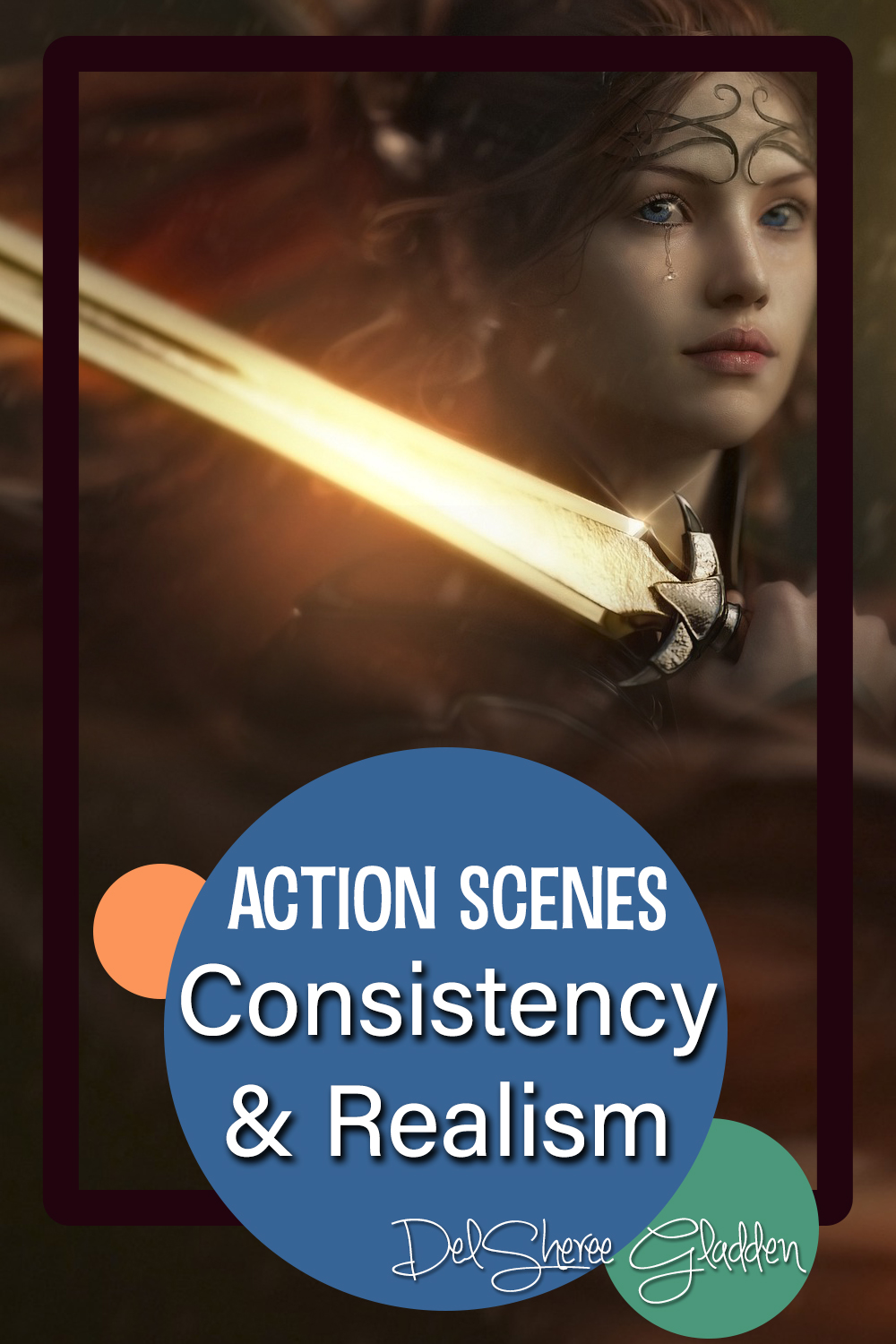
Action Scenes: Consistency and Realism

As with any writing project, it is important for the writing style to remain consistent throughout the project and for each scene to keep a foot in the realistic world, no matter the actual level of realism in the world and story.

Consistency in Style

When writing an action scene, there will be some changes in style depending on the scene elements involved, but the scene should not feel like someone else wrote it because of drastic alterations to the writing style. Maintain the style used throughout the story with small changes to increase the dramatic tension (more high emotion descriptors), change the pacing (shorter, more urgent sentences), remove any comprehension barriers to move the reader through the scene smoothly (avoid using complex or unfamiliar words that might trip the reader up), and so on.

Actions scenes will necessarily have slightly different language and structure than exposition, but it should still mesh with the rest of the story. Sudden, drastic changes pull the reader out of the story. If you tend to include detailed description in other scenes, be more sparing with such language during action scenes, but don’t necessarily cut it all out completely. If movement and technique are important to the fighting style and have been included in less action-based scenes, include some of that in an action scene, but don’t overload the readers or sacrifice the flow of the scene in order to include it.

The characters should sound the same when it comes to spoken dialogue or thoughts, as well. Characters involved in an action scene should not suddenly sound like anime characters, not should they start spouting Shakespearean-style soliloquies. Internal dialogue should not vary widely from the character’s norm. If the character is highly internal and previous scenes have included a significant amount of internal thought, include some in action scenes where appropriate but keep in mind the pacing of the scene. Slight shifts to mimic panic or desperation work well, but complete changes make the character feel like a different person.

Writing style should stay consistent. Don’t suddenly change stylistic elements like syntax, tone, mood, exposition, or narration. The scene will feel out of place and confuse the reader.

Maintaining Realism

Action scenes aren’t technically realistic in many cases. Characters don’t take as much damage as they should or are able to maintain stamina way longer than is reasonable, or have skills outside the normal human range. Even so, actions scenes should maintain an air of realism to keep the scenes grounded, even when set in a completely fantastical world.

Action scenes must be real enough to convince readers to suspend their disbelief. The action taking place should make sense for the world and the characters. There may be surprises, of course, but a piece of action should not make the reader stop and question the reality of what happened. This halts the scene and can frustrate the reader.

Avoid impossible abilities to keep characters from coming off as indestructible. Whether a completely realistic world or a non-realistic one, there are still rules the character must comply with and work within. An ability or action that breaks rules with no explanation not only stops reading progress, it risks alienating the reader.

Use realistic (for the world) healing times and make injuries impact future events. Broken bones take weeks, if not months, to heal without magical or advanced scientific methods. Injuries can be great barriers to a character reaching a goal if used properly. If you don’t want a character out of commission for a long period of time, choose a more appropriate injury for what you have planned.

Research weapons and how they work, including the sound, feel, power, weight, construction, impact, etc. Different types of guns feel very different to fire, and metal swords are much heavier than what is typically portrayed, with the exception of fencing and dueling types of blades. You want to be able to accurately describe the action using all five senses.

Watch videos when possible to better describe movements and reactions of people engaging in the type of action you’re attempting to describe. Ask people who participate in the activities involved when possible to learn more about the feel of the movement and the difficulty of responding when in a high-intensity situation. This will help you to be more consistent in writing how characters fight, as well. Learn the proper terminology and work in enough to sound realistic without overwhelming the reader. Experts are usually very willing to help with this.

Taking a little extra time to learn about the realistic elements of various types of action can make the scene come alive for the reader.