Story Structure: Overview

This series will talk about how to structure a story that keeps the reader’s attention and tells a story in the best possible way.

The Basics of Story Structure

Exposition/Introduction

This is where you will introduce the characters, establish the setting, and present the primary conflict. All of this generally happens in the first few chapters or the first act. The goal is to orient the reader in the characters’ lives before you begin adding any major conflicts.

This helps the reader connect with the characters so they will be invested in the outcome of their story. If a reader can’t connect with the main character(s), there’s a good chance they will stop reading. The setting should also be relevant and interesting, so they character appears to be existing in a real world (whether realistic or fantastical).

It’s also important to give readers a good idea of what the main problem is that the characters(s) is dealing with so they know what type of story they are reading and what the character(s) must overcome. This sets up the reader’s expectations for the rest of the story.

Rising Action

This section is where you should introduce the primary conflict and set the main storyline in motion. This should follow with the expectations you set up for the reader during the introduction. Succeeding events become more complicated as the story proceeds, creating stumbling blocks, tension, interest, and excitement.

Rising action isn’t a straight line, however, so problems and complications should be interspersed with moments of calm, reflection, or positive movement. The action will continue to rise overall, but with dips along the way. This gives the reader a break and allows time for reflection and thought.

Climax

This is the major turning point of the story. All the problems and complications established during the rising action will come to a head. There is high tension and conflict, and stakes are at their highest. The risk that things might not turn out should feel real to the reader, even if they know deep down that everything will turn out the way they are hoping.

This is often a moment of crisis that leaves the reader wondering what will happen next. If you are writing a romance, the reader expects there will be a happily ever after ending. You likely won’t get the reader to really think a happy ending is out of the question, but the goal is to make them doubt the how of how that happy ending will be reached. This heightens a reader’s investment in the outcome and deepens the connection with the characters.

Falling Action

After the climax, the story begins to calm down and starts working toward a satisfying ending. Characters decide what action to take to resolve conflict. These decisions and actions should be realistic and somewhat surprising. Easy and predictable resolutions tend to fall flat and disappoint readers. Make sure all the loose ends are tied up, explanations are revealed, and the reader learns more about how the conflict is resolved.

Resolution

At this point, the main conflict is resolved and the book ends. The story, however, should have the illusion of continuing on beyond the page. This is true even if the book is a standalone and will not have a continuation. Give the reader a chance to imagine how the characters’ lives play out. This adds to the satisfying quality of the ending.

Excerpt: Memory’s Edge Part 2

Before I move on to the next themed blog series, now that I’ve finished the Marketing Primer series, I thought I’d share an excerpt from Memory’s Edge: Part 2. This is the book I’m currently working on hoping to finish in the next month.

By the time lunch finally arrived, Gretchen was exhausted on every level. She only dragged herself out of her chair to lock the door. Before she could accomplish the task, she saw Desi sprinting down the hall and opened the door for her. Her friend crashed into her, throwing her arms around her and squeezing her hard enough to hurt.

“I am so mad at you! You know that, right?” Desi demanded when she finally pulled back. “I called and called and called!”

Yanking her friend into the classroom, Gretchen locked the door behind her and headed for her desk. Desi plopped down on top of a nearby student desk and glared at her friend. Gretchen collapsed in her seat. “I want to say I’m sorry, but I just couldn’t face talking to anyone.”

“I was so worried about you! John too! It was like I suddenly lost you both!” Her hands flew up dramatically. “How could you do that to me?”

Seeing the tears in her friend’s eyes broke Gretchen down. “I’m sorry, Desi. I know it wasn’t fair, but I just couldn’t. I still haven’t talked to my parents, either. I couldn’t even go home.”

Desi huffed. “Thank goodness Carl at least had sense enough to let everyone know you hadn’t gone off the deep end. I would have banged down your door if he hadn’t texted to say you were alive and as emotionally stable as could be expected.”

“If you had tried to bang down my door, you still wouldn’t have found me.”

Seeming a little surprised by that, Desi asked, “You’re still staying at Carl’s?”

Gretchen looked away from her friend. “Do you remember what the inside of my house looked like before we left for New York?”

Desi sighed as realization set in. “Oh, honey, I’m sorry. I hadn’t considered all the wedding prep scattered everywhere. Of course you didn’t want to go home to that.” She reached forward and squeezed Gretchen’s hand. “Have you heard from John yet?”

Looking up at her, Gretchen stared in confusion. “Why would I? He’s not coming back. He has his old life back now.”

“Yeah,” Desi said, “but what about all the wedding stuff, the catering business, his clothes and things, everything he left behind.”

Blinking away tears, Gretchen said, “It’s not like he needs any of it now, and I’ll deal with the wedding stuff eventually on my own. It’s not his problem anymore.”

Wincing, Desi asked, “So you looked him up too?”

She didn’t want to admit it, but Gretchen nodded. “I can’t even comprehend how much money he and Corey have. There’s nothing he left behind that he can’t buy again.”

“Except you.”

Gretchen glared at her friend. “It was the right choice.”

Propping her elbow on the desk, Desi dropped her chin into her palm. “I know, honey, but that doesn’t mean you can’t be hurt by his choice.”

“It was my choice as much as his. I’m the one who said goodbye and left the stage.”

“Because you knew what choice he had to make and did it for him so he didn’t have to.”

“It was the right choice,” Gretchen whispered as tears spilled down her cheeks.

Practically laying herself out across the desk, Desi ignored the fact that she was wearing a skirt and hugged her friend fiercely. “Sometimes right choices hurt worse than wrong ones.”

Gretchen clung to her friend for several long minutes before finding enough strength to pull back. “Thank you.”

She smiled and sat back up. They were quiet for a long time before Desi spoke again. “It’s going to be so weird without him here. Jake was so upset when he realized John wasn’t coming back.”

Gretchen instantly felt bad for not considering the impact of John’s leaving on anyone else in their life. Desi had gone through several boyfriends while John lived with Gretchen, but he and Jake had become very close over the last several months. Desi cared about him like a brother as well. And her parents…despite Gretchen’s mother warning her about the potential heartbreak loving John would cause, they both adored him and loved him like a son. They must have been as heartbroken over losing him as they were knowing she was hurting over the loss.

“I need to call my parents when I get home,” Gretchen said tearfully.

Desi smiled sadly. “We’re all going to miss him. I know it’s not the same for us as it is for you, but we do understand some of what you’re going through. Stay with Carl as long as you need to, but know we’re all here for you, okay? Whatever help you need to sort things out, all you have to do is call.”

Gretchen reached over the desk and hugged her again. “Thank you.”

They pulled back from each other and Desi sighed. “I better get going. I have to prep for my next class. Pottery week…” She shook her head at the impending mess and stood. “Call me later, okay?”

Gretchen nodded and watched her walk out. Another half a day to go. Then two more days until the weekend. Then one more week until spring break. She could last that long. Maybe by then she’d be ready to start putting her life back together.

Marketing Primer: In-Person Marketing and Events

Setting up in-person events takes making connections and planning in advance.

Types of Events

  • Book signing (new releases, special events)
  • Speaking engagements (author talk, informative lecture)
  • Community organization events (any event that allows vendors)
  • Writing groups (guest speaker)
  • Art collaborative events (art walks, art fairs/festivals)
  • Craft fairs (schools, senior center, maker markets)
  • Community festivals (seasonal, renaissance, kids)
  • School or library talks (information presentation, career day)
  • Informational presentations (conferences, comic cons, literature events)

Setting up a book signing

Book signings are not limited to book stores, but if you do want to hold a signing at a bookstore, focus on local and independent stores. Chain bookstores often don’t work with indie authors because of buyback restrictions and they may not take consignments either.

Local stores are more flexible and offer better royalty splits on books sold during a signing or on consignment books. A 60/40 split is common with many indie bookstores when books are excepted on consignment.

If you wat to branch out from bookstores, pitch libraries, restaurants/cafes, or a business related to the book’s theme. When working with a for-profit organization or an event center, you will likely need to rent the space or give a percentage of sales to the venue or owner.

Be sure to book your signing 1-2 months in advance. Venues or organizations who hold regular events need plenty of time to fit you into the schedule. It’s also important to give yourself enough time to make sure you will have books available.

Speaking engagements

You don’t have to wait for someone to ask you to speak to their group or organization. Prepare a presentation and pitch yourself to groups.

Author talks or informational presentations are great options when you don’t have a new release or something to celebrate but still want to stay active in the community. Pitch yourself to bookstores, libraries, charity events, schools, Comic Cons, writing conferences, or festivals.

Have a topic ready to pitch. Write out a 100-word synopsis of the content and have a sample ready for consideration. Don’t just talk about your book. Focus on the issues your book deals with or pick a writing or book related topic you feel comfortable speaking on.

Charge a speaking fee or ask to sell books in lieu of payment.

People do not buy goods and services. The buy relations, stories, and magic.

Seth Godin

While marketing can be intimidating and time consuming, the more you focus on building relationships with readers, the more success and satisfaction you’ll experience.

Marketing Primer: Long-Term Marketing

A solid long-term marketing plan is a big factor in determining success.

Daily Marketing Tasks

Social media posts should be going out daily, but that doesn’t mean you have to do it daily. Schedule a full week in advance to free up time by using services like Buffer, Hootsuite, TweetDeck, or Sprout Social. Which will work best will depend on which social media platforms you plant o use, how far in advance you want to schedule, and your budget.

Once you have your posts going out, make sure to engage! Respond to comments and messages, like and thank shares, and follow/friend as you see fit. Join conversations about books and publishing as well.

If you’re going to blog, always be on the look out for content ideas and plan your schedule. Even if you aren’t going to blog weekly, you should always be gathering topics and ideas.

Starting pinning on Pinterest and engaging with followers by liking/pinning their pins. Posting around 5 pins per day has been shown to help grow traffic on Pinterest.

Keep a running list of links, stories, pictures, etc. that you can share as content on social media. Also curate a list of posts that get good engagement and reshare them every so often.

Answer all messages and emails you receive, even if it’s just a quick thank you.

Review analytics of posts and ads daily so you know what’s working and what’s not.

Research new information and opportunities. Never stop learning because the marketing world never stops changing!

Weekly Marketing Tasks

If you are going to blog, blogging is a good way to keep fresh content rolling in and keeping your website relevant in search results.

Small focused promotions also work well on a weekly basis. These may include small giveaways ($5 gift card, ebook, bookmark, etc.), contests with small prizes, newsletters, questions posed to readers on social media, etc.

To break up your promotion submissions, send a few each week. Rotate through your books if you have more than one. Keep in mind any upcoming promotions you have as you submit and plan accordingly.

Review ad performance over the past week and make changes or turn off ads that aren’t performing well.

Cross promote with another author through newsletter or social media post swaps.

Send out relevant email blasts if you have news that wasn’t included in your last newsletter and can’t wait until the next schedule newsletter. Don’t overuse this!

Pick a day to sit down and schedule daily posts for the next week.

Monthly Marketing Tasks

Plan a medium-sized focused promotion, such as a giveaway with a slightly bigger prize ($10-$20 gift card, paperback book, etc.), offer a book for sale or make a special offer with purchase, or hold a contest.

Send out your regular monthly newsletter (if that is the schedule you choose), and include all relevant updates from the previous month and news about what is coming up in the next month.

Seek out reviews from fans, bloggers, services, etc. Set a realistic goal for how amny reviews you want to get each month through direct interaction.

Focus on one book or series each month. Plan your social media posts, review offers, free books, Pinterest board activity, character interviews, etc. around the book or series you are featuring that month.

Incorporate any holidays or events into your posts and promotions. If you want to include listing sites or ads, plan these well in advance if it’s around a holiday.

Plan the next months ads and create the graphics you will need so you aren’t wasting time later trying to create or purchase them at the last minute. Review monthly analytics and make adjustments as needed.

Yearly Marketing Tasks

Schedule 2-4 big marketing pushes for the year. These may be centered around a new release, holiday, event, birthday, etc. If you can plan a few outside of times when everyone else is engaging in marketing pushes (holidays), you’re likely to get more interest.

Be as creative as possible with events, posts, and prizes. Try new tactics and evaluate whether or not they worked.

Plan your release schedule for future books and, if possible, spread them out evenly throughout the year. Be realistic, though!

Set goals for the next year for growth and plan for how to reach those goals.

Marketing Primer: Marketing a Book Launch

Launching a new book typically takes extra marketing and a specific plan in order to make it a success. In this post we’ll discuss what extra tactics you can take to launch in each of the three phases of planning a book launch: pre-release, release-day, and post-launch marketing.

Pre-Release Marketing Planning

Start as early as possible with your pre-release marketing! Plan out what promotional materials (physical or digital) you plan to use and have them prepared as early as you can so you can start sharing them.

Gather reviews for release day by recruiting book bloggers, beta readers, or review services. Remember that you should NEVER pay for reviews. Keep track of everyone who agrees to provide an honest review and follow up with them on release day. Ask them to send you a link to their review so you can share it. Thank reviewers who follow through and keep a list of those who don’t so you can decide who to send review copies to for your next releases.

Another pre-release marketing option is to make a book trailer. This can be posted on YouTube for long-term availability and shared on social media in marketing posts. Video consistently get more interaction on social media than pictures and text.

Setting up your book as a pre-order is another marketing option. This requires you to have your book files and cover ready further in advance, but it gives you a link to use in your marketing as well. It allows readers to buy your book when they are interested instead of hoping they will remember to purchase it after it releases.

Blog tours are not as popular as they once were, but they can still be useful for boosting visibility. They are not typically helpful for revenue producing, so evaluate where your budget can be best spent before paying for a blog tour.

If you plan to host any in-person events, set these up several months in advance and make sure your book files will be ready early enough to be able to order copies of your book in time for the events.

Release-Day Marketing Plan

Release day (week/month) sales within the first 30 days are important for rankings retailer sites. This is a prime time to focus on ads, promos, and social media marketing. Watch ads closely to see which are working best and turn off or adjust those that aren’t in order to keep your marketing as effective and efficient as possible.

Send out an email newsletter blast to your subscribers on release day, and then a few days to a week later as a reminder or only to those who didn’t open the first email. It’s a good idea to also ask readers to post an honest review when they finish reading as a way to help you reach more readers who might like your book. It often helps to mention that a review doesn’t need to be more a few sentences so readers don’t feel intimidated.

Host a release party (virtual or in-person) to celebrate the release. Digital options include Facebook parties, livestreaming a reading or Q&A session, Twitter chats, live YouTube video, or utilizing TikTok or Instagram. In-person options include a book signing, author reading, or party with friends and readers.

You can also schedule (or have a PR company set up) blog features, radio or podcast interviews, or media appearances. Traditional media is less effective for launch marketing than avenues such as podcast interviews and live social media appearances.

You can also off incentives for readers to buy your book, such as giving them a free gift like a bonus short story or signed bookplate or digital authorgraph. Be sure you check Terms of Service on retailers regarding incentives, especially in relations to asking for reviews. Amazon is very strict about this.

It’s also important to update all of your social media and website with links and graphics, including cover art if that hasn’t been updated already. Update your social media bios with a link to your book. You may only do this temporarily if your regular link is to your author website or something specific you are promoting.

Post-Release/Launch Marketing Plan

The goal of post-launch marketing is to continue the momentum you’ve built in the previous two phases. This takes consistent marketing for several months that is focused on your new release, but not as robust as during the launch period.

In the months after a release, make use of free social media group posts and paid ads as your time and budget allow. Schedule newsletter spots with companies that permit new releases. Once a month, remind your newsletter that you new release is now available to catch anyone who hasn’t opened your newsletter recently but might be interested in your new book.

Share positive reviews, blog posts, and pertinent links you cultivated during the previous two phases. Continue to seek out reviewers and build your reviews up on retailer sites. Utilize your street team members to share and post about your new release, what they liked about it, or to recommend it to likeminded readers.

The key of post-release marketing is to keep the book fresh in readers’ minds by incorporating it into what you’re already doing with your others books. If this is your first book, blend in updates on your next project while still promoting your book to keep readers excited for more!

Marketing Primer: Non-Social Media Advertising

Social media advertising is not the only option available to authors to market their books. Here are a few other avenues to consider.

Listing Sites

Listing sites offer spots in their newsletter for authors to advertise new releases, special pricing, or free books. Newsletter ads provide short term results and benefits, with a period of additional sales at a higher price or sell-through on other books in a series. This period after the initial promotion is where most of the revenue is made. These types of ads range from inexpensive to very expensive depending on the size of the service’s list. Big lists like BookBub can be very effective and produce a longer period of additional sales.

Banner Ads

Banner Ads are advertisements put in a prominent stop (usually the top of the page or sidebar) on a website. It’s important to check a site’s monthly or daily traffic before purchasing an ad. It’s almost important to make sure the price is promportional to the amount of traffic. These types of ads are moderately expensive, but also generally effective. The results are largely short term.

Review Services

Reviews effect buyer confidence, so it is important to seek out reviews for your books. Amazon Terms of Service prohibit paying for reviews or exchanging products in return for reviews, with the exception of providing a free book in exchange for an honest review.

Paying to have your book included in a review service listing is a viable way to increase your reviews and does not violate Amazon’s TOS. These services can be rather expensive, depending on the service. Service with large reader bases will cost more than smaller services. These types of services can be very effective at increasing reviews and provide long term results.

Marketing Primer: Paid Advertising

Paid advertising doesn’t have to be expensive. Many authors start with very small budgets and increase as they become more adept at using their marketing dollars.

First, let’s learn some of the lingo and basic concepts…

Social Media Advertising can be done on a small or large budget. It is effective for reaching a targeted audience. There is a learning curve (steeper on some platforms than others), but there are a lot of resources available to help authors learn how to maximize the budget and effectiveness.

Influencer Marketing involves an industry expert or celebrity recommending your book or other product to their followers in exchang for a fee.

Banner Ads are the clickable graphics at the top of many websites. They are one of the most effective ways to advertise because they often grab the visitors attention right away. These can be more expensive than other types of ads, but they tend to be worth the money on bigger book-related sites.

Affiliate marketing involves becoming an affiliate with a retailer or organization and hosting referral links on your website or in social media posts. You get paid per click, but you do have to tell visitors/followers that it is an affiliate link.

Ad Retargeting is basically a reminder for customers to check out a product. even after they leave your page or a page you’re advertising on. It is most effective for high traffic websites, but work well with banner ads as well.

A Call-to-Action (CTA) tells customers what you want them to do (buy, sign up, join, etc.). It’s important to have a strong CTA in ads so the customer isn’t left wondering what the next step is.

Return On Investment (ROI) is the ratio of net profit and cost of investment. You want to evaluate ads you run while they are running and after they are completed to see if they were worth the investment. An ROI of 1-2% on Facebook is considered good.

Cost-Per Click (CPC)/Pay-Per-Click (PPC) breaks down you ad spend to see what each interaction is costing you. Ads are usually about twice as effective at getting clicks as organic posts. An average CPC/PPC is $0.25-0.30 average on Facebook in U.S.

Click-Through-Rate (CTR) is the percentage of customers who click through to the next step. Having a clear CTA improves CTR. A CTR of 2-5% on Facebook is considered good.

Now lets look at what advertising option work well for authors

Amazon: Ads on Amazon are set up through your KDP dashboard. You can target similar books or authors. Amazon ads are very effective for most authors, but there is a steep a learning curve. Sign up for an Amazon Ads class to learn how to best utilize this platform.

Facebook: Paid ads have a wider range than boosted ads, which mainly targets followers. In order to serve paid ads, you need to set up your Business Center account with Facebook and be approved.

Pinterest: Advertising on Pinterest allows you to promote pins, create campaigns, and aadvertise stories. Pinterest is effective for advertising because pinners are ready to buy and its user base in constantly growing.

Instagram: Instragram ads can be setup up directly on the app or through a connected Facebook Business Center. You can promote images, videos, stories, and collections. Instagram has high interaction, which makes it an effective advertising option. It can be pricier than other platforms for high engagement industries.

Twitter: The type of ad that tends to work best for authors are objective-based campaigns. These enable you to promote tweets, accounts, trends, or moments. Some readers have very good results advertising on Twitter and others don’t. Consider the strenth of your platform on Twitter before advertising.

Goodreads: This is a reader/book lover focused platform. It can be an effective advertising option, but mainly for those who have cultivated a strong presense there. There are two advertising options on Goodreads: Giveaways of Kindle or print books, which cost $119, and digital ads, which must be set up through a rep. There is no self-serve option. Advertising on Goodreads tends to be quite pricey and less effective than other platforms.

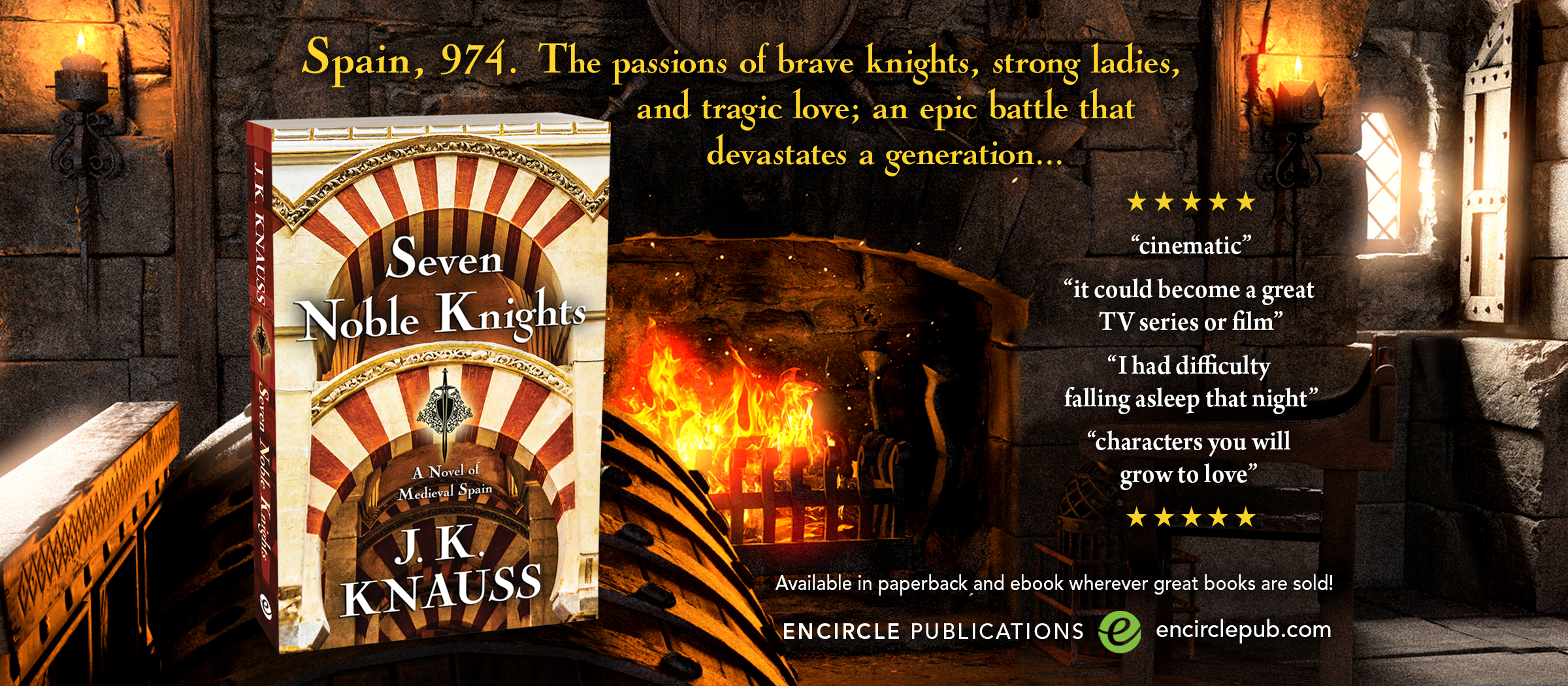
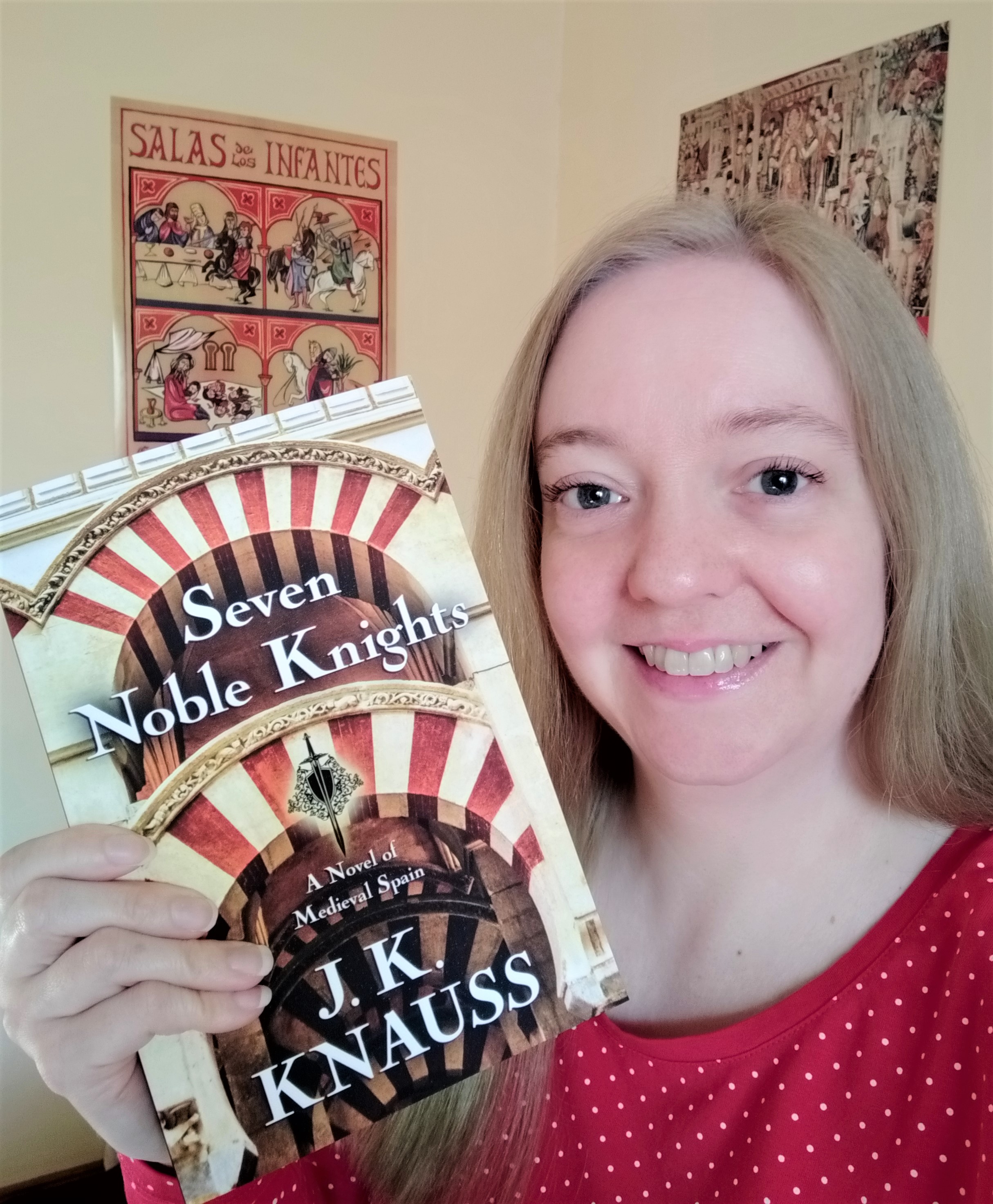
Seven Noble Knights by J. K. Knauss

J. K. Knauss’s epic of medieval Spain, Seven Noble Knights, is now available from Encircle Publications. You can order it here or here, and see interviews, historical tidbits, and videos here. Sign up for castles, stories, and magic at JessicaKnauss.com.

Excerpt from Part One, Chapter III: The Wedding

Young Gonzalo’s uncle, Ruy Blásquez, is receiving Doña Lambra as a bride in exchange for his service to Castile. Gonzalo isn’t at all sure Lambra should be marrying his uncle, and during the ceremony his sensations run toward the culinary.

Doña Sancha shooed her sons away from the cathedral door and drew dried herbs and flowers from pockets Gonzalo hadn’t known were inside her tunic and cloak. With a stick, she carved a large circle on the hard earth. Doña Sancha set the herbs and flowers inside the circle in a pattern with meanings she might have shared with a daughter, but were a mystery to Gonzalo.

“You’ll stand here,” she told her brother, Ruy Blásquez. “When your bride comes from that side, you’ll step inside the circle together.” She arranged her husband and sons on Ruy Blásquez’s side of the circle. Gonzalo ended up next to his uncle, so close he could hear each shallow breath he took.

Count García arrived with a full complement of knights and squires and four banners in white with red castles, as well as a fiddler and a flutist who made ready to play. So many people in the plaza must have been making the loudest ruckus since the city had been won from the Moors, but Gonzalo heard nothing.

From between the buildings at the far end of the plaza emerged forty women who walked with their hair covered to emphasize their married status. Their laughter and singing couldn’t distract Gonzalo from Doña Lambra, who tottered on their shoulders.

An heirloom beaded necklace competed with her yellow hair, shining in tight plaits on her shoulders with ornamental brass tips that looked as if they had come out of a treasure chest long ago. A mail girdle, inlaid with brass and pieces of jet at the edges, cinched her bright blue tunic from under her breastbone to down over her hips. Gonzalo shivered at the thought of the bitter touch of the matching mail sleeves, from the decorated wristlets up to her shoulders. A burgundy-colored cloak edged with three rows of golden braid was fastened over her shoulder with a gilded brooch in the shape of a lion rampant. A square cap, decorated all around with braid and gold carbuncles, looked like a royal crown. Gonzalo imagined he wasn’t at his uncle’s wedding, but that this bride had come from the farthest reaches of Christendom to marry the King of Navarra or León.

The married women set Lambra down in the middle of their ranks. She let the cloak fan out behind her unsteady stride. Her face was frozen into a grimace like the one the Virgin Mary wore as she cradled the Savior’s dead body inside the cathedral.

Gonzalo remembered Lambra’s grin at the banquet days before, when her mouth had dripped red with juices from the roasted bull’s testicles and the sauce-engorged bread trencher. Each time she received the goblet, she had made sure to turn it so that her lips didn’t touch the same spot as Ruy Blásquez’s. She didn’t take the same precaution against Álvar Sánchez, seated on her other side. Gonzalo could hardly taste his food through a choking desire to throw his eating knife across the table into the gloating knight’s hand so it could never touch Lambra so familiarly again.

There he was now, that upstart Álvar Sánchez, wearing just as juicy a grin, so close to Doña Lambra that the obnoxious curl on the toe of his boot intruded on the magic circle.

“What is that blasphemous behemoth doing there? Shouldn’t a member of the groom’s family stand next to the bride?” Gonzalo whispered to Gustio.

Gustio knocked his elbow into Gonzalo’s ribs. “Why? Were you hoping it would be you, little brother?” He chortled until their mother hissed at them to be silent.

Count García was addressing the crowd. “…with these deeds, Ruy Blásquez has earned as a bride my loveliest cousin, probably the most beautiful woman Castile has seen since my mother joined the Kingdom of Heaven. May they live many more years and have many loyal Castilian children.” He raised his arms, which the crowd took as a sign to cheer and shout.

Gonzalo noticed that his uncle had already moved into the circle and reached for Lambra’s hands. She was looking at Ruy Blásquez, but not with love or even curiosity. It was a look of judgment. Gonzalo tried to imagine how his uncle’s soft eyes, long nose, and weak chin fared on Lambra’s scale.

“I receive you as mine, so that you become my wife and I your husband,” Ruy Blásquez said. Gonzalo was relieved to glimpse him smiling widely, displaying his straight, white teeth to his judge in the form of a bride.

Ruy Blásquez smiled and waited, waited and smiled. Gonzalo witnessed a thousand expressions cross Lambra’s face like clouds in a stormy sky. At last, Lambra’s maid emerged from the crowd and leaned over the circle. “I receive you as mine…” she prompted so quietly that Gonzalo had to read her lips.

“I receive you as mine so that you become my… husband… and I your… wife,” said Doña Lambra, her eyes narrow. She pulled her hand away from Ruy Blásquez to wipe at her plump lips, as if the words had sullied them.

She craned her neck to look at Álvar Sánchez and Gonzalo knew she wished she had said the words to him. His heart beat faster. Then she shifted her gaze to Gonzalo. He felt as if he were smothered with the parsley, fennel, red carrot, and beet sauce from the banquet. Such was the hunger he saw in her eyes, a hunger he couldn’t help but feel, too, and which raged all the more, the more he tried to contain it. He remembered the way the bull’s testicles had flopped onto Doña Lambra’s trencher under their own weight and the way they deflated when she plunged her knife into the center of the sacs.

He stopped a startled cry in his throat.

“Long live the newlyweds!” The crowd shouted until they were the only words Gonzalo remembered ever hearing.

Buy a copy of Seven Noble Knights on:

You can also pick up a paperback copy at your favorite indie bookstore: https://bookshop.org/books/seven-noble-knights/9781645991205.

Marketing Primer: Getting Started with Promotions

Maintaining a consistent schedule of promotions helps authors remain in the forefront of readers’ mind.

Before you start scheduling promotions, make sure you make quality promotional graphics ready!

Preparing Promotional Materials

Give readers something to remember you and you book both in-person and online. This starts with high quality graphics and professional design. This doesn’t mean you have to spend a lot of money. Using graphic editing software like Canva or Book Brush allows anyone to create eye-catching graphics for print or online use for a reasonable monthly fee. There are also design services that are very affordable (many are authors running side businesses).

Physical materials you may need for in-person events and sending or selling to readers may include: paper bookmarks, business cards, post cards, book plates to sign and mail, banners and posters, and flyers.

Virtual materials for social media promotion and digital advertising may include: teasers, quotes, digital autographs, posts to save/share, videos, book trailers, social media banners, 3D cover art, or logos.

Unique promotional materials can make you stand out. Consider options such as book-themed jewelry, ribbon bookmarks, book plates, mugs, t-shirts, pens, etc.

Personal materials you want to have prepared include: live reading selections, Q&As, chat sessions, etc.

Setting up Cross Promotions

Cross promotions are all about help other authors while expanding your readership. Here area few ideas to consider getting involved with:

Newsletter Swaps: You agree to feature another author’s book in your email newsletter and they share yours in their newsletter. The author with the smaller newsletter gets the most benefit, but both authors are exposed to new readers. This works best with the features books are in similar genres.

Combined marketing pushes: These are especially common and effective around themes or holidays. All authors promote a group of books, usually with a single landing page. This can work for free or paid books.

Guest post/Interview trades: Share guest posts, promos, or interviews on each others blogs/websites. This increases your general exposure and opens you up to new readers as well.

Multi-author events: Join other authors in celebrating a theme, holiday, or just to have fun. Consider hosting Facebook parties, Twitter chats, a group sale, an author panel Q&A.

Box Sets: In a box set, each author contributes a book and all the books are sold as one unit in an ebook format. All authors MUST agree to promote and share any advertising costs. Be sure to vet the other authors involved before signing a contract.

Free Marketing Avenues

Next week I’ll discuss paid marketing options, but don’t forget about the many free avenues available for marketing a book. Free marketing opportunities are often time consuming, but can be very effective. Here are a few ideas to consider:

Facebook: Join some of the many marketing groups and share links to your books. Post to your author page on a regular basis. Make sure to keep promotional posts to 25%. Run a giveaway on your author page for an ebook or signed paperback. Host a Facebook party to celebrate a new release, book anniversary, your birthday, etc.

Twitter: Use the Pinned Tweet feature to highlight a buy link or promotion. Tweet daily with interesting content and occasional promotions. Follow readers and authors and start book-related conversations.

eBook Submission Sites: There are a wide variety of submission sites, many genre specific. While many do charge a fee, there are some that are free to submit to. It can be time consuming to submit individually, but can gain you new readers and sales.

Cross-promote: Team up with other authors to share each others posts, tweets, pins, or links. Some author groups do this regularly, such as ChickLitChatHQ on Fridays.

Free ebook offer: Offer readers a free ebook, novella, excerpt, etc. on a permanent or temporary basis. Many authors use a free product as a reader magnet to increase newsletter subscriptions.

Video and Audio: Make use of YouTube for Vlogging, book trailers, author readings, or a weekly check-in or chat. Start a radio show or podcast to talk about books, writing, or whatever you’re interested in.

Creative Marketing

The more creative your marketing efforts are, the more memorable they will be. Try to match marketing to the theme or a unique feature of your book(s).

A great example of this was the launch of “The Girl on the Train.” On release day, the publisher deployed dozens or more employees onto subway trains with copies of the book. They rode around on trains for several hours reading copies of the book and engaging in conversations about it.

Other examples include “The Liar Society” authors and promoters wearing pink wigs to match the hair of the main character, a photography-themed book author ran a camera giveaway and Pinterest contest, an author/musician offered a free digital music album with purchase of his book.

Don’t be afraid to try new ideas!

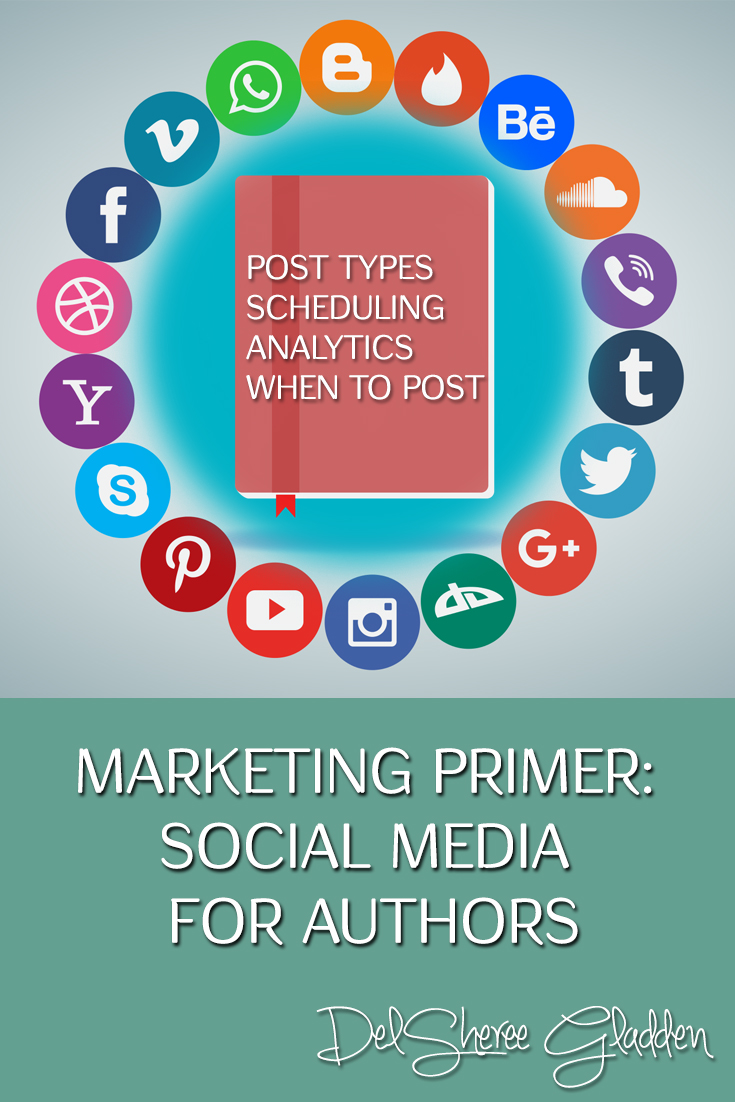
Marketing Primer: Utilizing Social Media

Before we delve into how to use social media effectively as an author, here are a few reminders about the purpose of social media to guide your planning.

The purpose of using social media is NOT JUST TO SELL BOOKS. The purpose is to interact and cultivate fans and a community of readers.

To do this, it’s important to share useful information, use humor to make people laugh, inspire people, share the LOVE for other authors so it’s not about you all the time, share the status or progress of projects to keep readers informed, build reader interest in your project with teasers, quotes, and sneak peeks, reward loyal fans with first looks, giveaways and prizes, share your writing-related (or personal) news and events, and show your personality and share your interests with your readers.

What to Post of Social Media

Follow the 25% rule: Promotional, Informational, Personality, and Giving Back. Only 1 out of every 4 posts should be promotional.

Facebook: Posts that work well on Facebook include behind the scenes photos, quotes, fill-in-the-blank questions, true or false questions, open ended questions, blog posts about writing craft or in-progress projects, newsletters, announcements, teasers, sneak peeks of works-in-progress or new releases, live videos, excerpts, humorous memes, book/publishing-related articles, and personal interactions.

Twitter: The types of tweets the work well on Twitter include blog posts, interesting industry-related articles, quotes from famous authors, industry news of interest to other authors and readers, newsletters, announcements, Vine/YouTube videos, event updates, questions you would like readers to answer, Twitter chats, and impromptu thoughts to share with readers.

Pinterest: Pins that work well on Pinterest include product/book photos, writing guides, links to your ebooks, videos such as book trailers or author talks, infographics, quotes or tips from you or famous authors, blog posts, curated content geared toward writing or publishing, “life hacks,” instructional articles or videos, and arts and crafts.

Instagram: Because Instagram is very customer-centric it’s important to add value to images by providing specific price details when applicable. You can also share customer created pics, pics of YOU in day to day life, pictures of your non-writing interests, contests announcements, and product-centric pics. Focus on IN THE MOMENT pictures to share.

YouTube: This is a great platform to share book trailers, author readings or talks, updates or projects, and live Q&As with readers.

When to Post on Social Media

Here are some general suggestions based on research. Your personal schedule should be modified to accommodate individual account analytics and your personal time and energy available.

Facebook: 1-2 times/day, 3 times/week. Check your “Insights” to see when your fans are online most often to select posting times. It’s also important to review what types of posts fans are interacting with most as well.

Twitter: 3-30 times per day, spread throughout the day. You’ll typically see more engagement on weekends. Follow industry leaders and interact often.

Instagram: 1-2 times/day, 3 times/week. Check your insights for best posting times and pay attention to what types of post garner the most engagement.

Pinterest: 3-10 times/day. You’ll typically see more engagement on weekend mornings.

Blog: 2 times/week. Focus on producing HIGH quality content. Early mornings are typically the best times to post, especially early in the week.

YouTube: 1 time/week works well for most channels. Create a specific schedule and stick to it. Frequency varies depend on topic/brand. Research other authors and publishers working in your genres and see what they are doing.

Scheduling Posts

Scheduling your posts can be a huge time saver and help you stay on a consistent posting schedule. Most social media platforms allow scheduling through their own app or a third-party app. Some third party apps allow scheduling for multiple platforms/accounts.

Hootsuite:Works with most social media platforms. You can try it our with a free account, which will have limited options. The unlimited paid account unlocks all options, but is one of the more expensive services.

Buffer: With their free account, you can use up to 3 accounts and schedule a limited number of posts. Their paid plans allows for more accounts and unlimited scheduling.

TweetDeck: This is only for Twitter, as Twitter doesn’t allow scheduling from it’s app. This app allows you to easily manage multiple Twitter accounts and lets you set up different groups and trends to follow on the dashboard.

Tailwind: There is only a paid account option, but it allows for scheduling posts on Pinterest and Instagram. It will also suggests best posting time and gives # suggestions for each post.

Facebook Business Suite: This dashboard connects your Facebook and Instagram-linked account for scheduling, messaging, and analytics. You can only connect one Instagram account to a Facebook page.

Use Analytics to Update Your Marketing Plan

Most social media platforms offer at least basics analytics. These give you information on likes, comments, shares, visitors, referring sites, time online, top fans, popularity of content, fan location, and more.

Review your analytics regularly and update your posting times and content type accordingly to what fans/followers are liking and interacting with most. Track the effectiveness of changes or new tactics and continue to adjust over time.