Reworking ‘Date Shark’ and rediscovering my writing style

My characters were not who I thought they were…
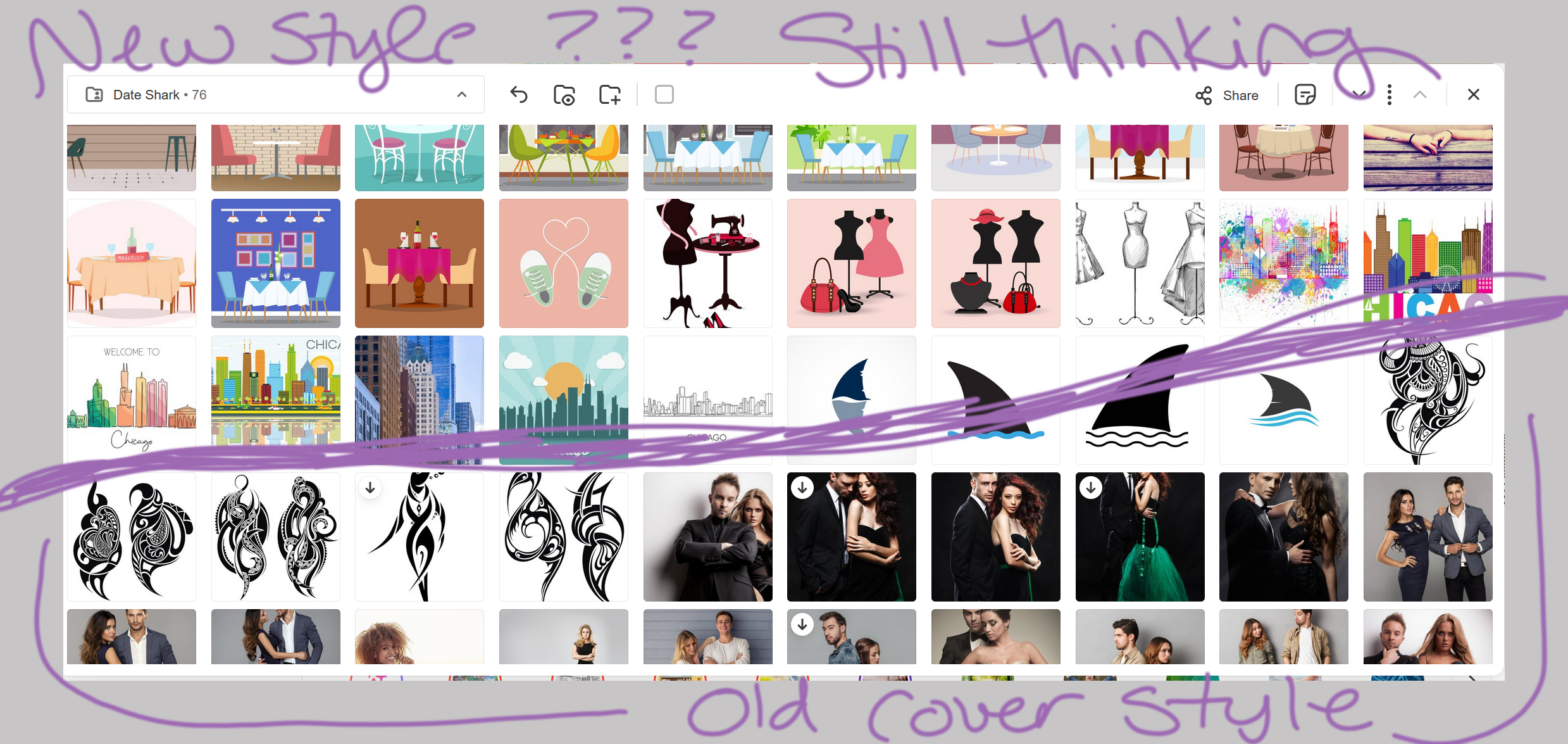
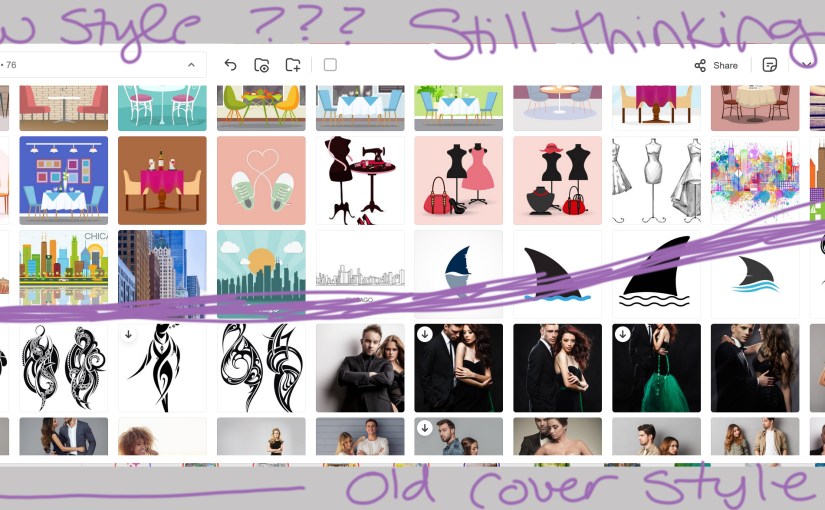
A visual comparison of how I am rethinking the cover design concept for the Date Shark series

I recently started revising Date Shark as part of my plan to overhaul my previous books before republishing under my married name (DelSheree Spinner) and my new publishing company (DelSheree Press LLC).

Date Shark seemed like a good place to start because it’s romance, which I have a better sense of how to market, it’s a complete series, and it’s had good response over the years so I thought it would probably need the least amount of work.

I’m about halfway through the first book, Date Shark (which will be getting a title update once I figure out what exactly that will be), and it did not take more than a page for me to realize I was way wrong on the whole “least amount of work” idea. The story structure is there and won’t require any major changes, but the characters are a different story.

They are not who I thought they were.

Let’s start with Leila, who has some issues but less so than Eli. I remember writing Leila to be sweet, naive, lacking in confidence, and talented and hardworking.

Some of that remains true looking back at her about 10 years later. What reads completely differently to me now is that she seeks out people who tell her who to be and how to live and she takes their advice with too little thought.

This creates stark inconsistencies in her character over the first half of the book. She’s eager to improve herself but doesn’t think through the suggestions she gets and allows herself to be bossed around and manipulated. It painted those as positive characteristics without meaning to. She’s supposed to be the heroine of her story, but others are driving the plot.

My main revisions with her character so far are to make her more thoughtful, even with her early naivete and low self-image. I know from the beginning that her character arc needs to involved recognizing when others are pushing her to bend to their will and plans and develop strength to stand up for her needs and desires. The area where she bends and wobbles in the early chapters are intentional now, allow Leila to learn from mistakes, not me mistaking gaslighting for compromise.

Who I remembered Eli being was charming, caring, a bit obsessive thanks to some personal demons, but a near-perfect best friend with the potential for more.

Upon this most recent reading, I realized he was basically none of those things. He was manipulative from just about page one, controlling, demanding, sneaky, and intrusive. I was genuinely shocked to realize I had written a character that was so unlike what I was trying to accomplish. My view of relationships was so skewed at that time that I didn’t see how un-Prince Charming Eli was behaving.
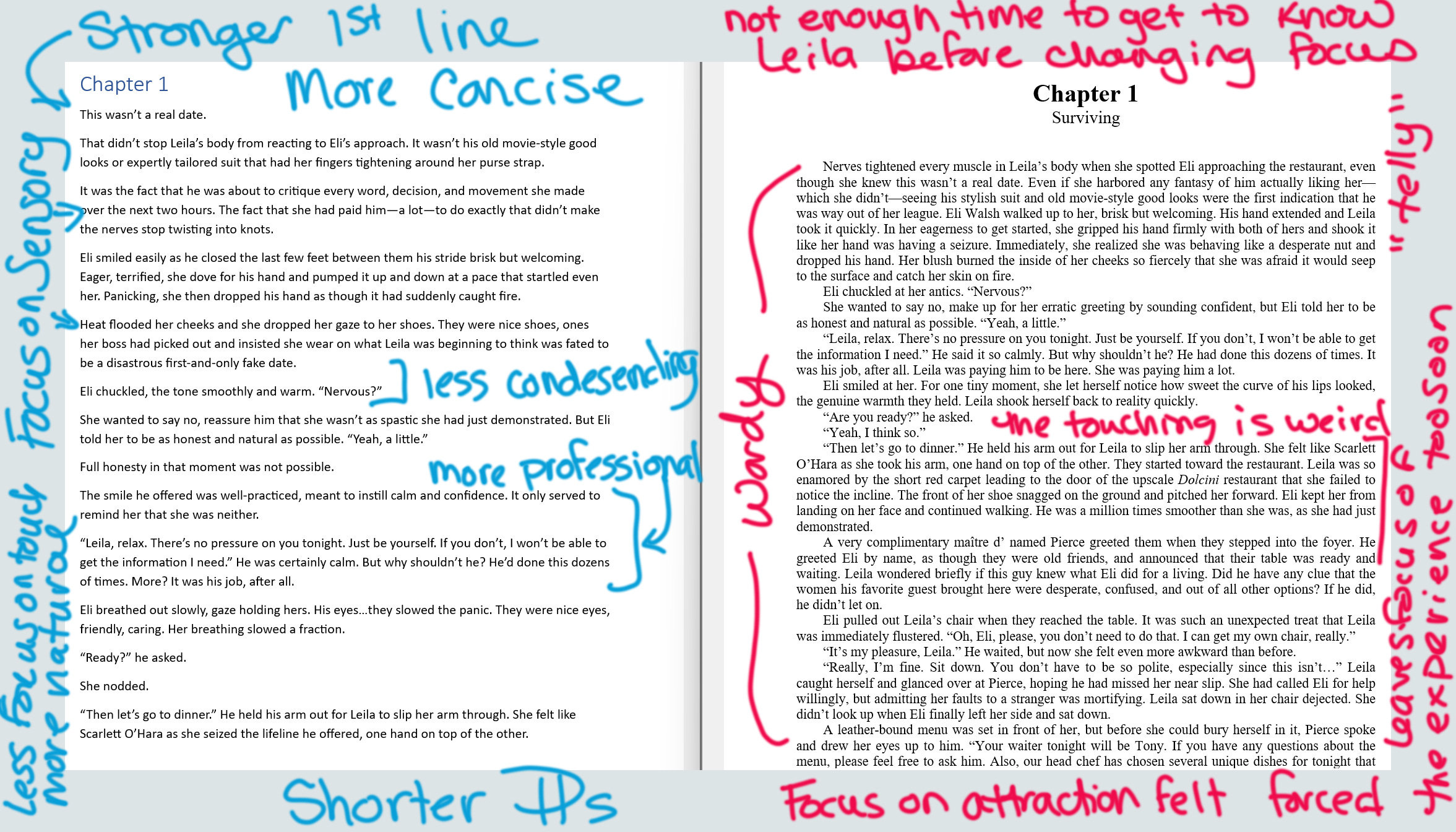
A look at how the open chapter of Date Shark has changed in my revision.

There was a scene early in the book when they meet to discuss their initial “fake” date where Eli basically diagnosis her dating life troubles. She is understandably anxious and demoralized in this scene after he’s laid out everything she did that could set off warning bells for a date. It’s forgivable that she doesn’t speak the thoughts in her head that explain her intentions or contradict the man she hired to provide advice for improvement. That’s part of her growth arc.

What’s not forgivable is how Eli attempts to manipulate the situation more than once through touch and by telling her what to do even after he has admitted to himself that he doesn’t understand why she came to him. He wants to manufacture ways to spend more time with her, claims it’s to help her grow under his tutelage, yet almost withholds an invitation from a friend that would give her an opportunity to test out his advice purely out of jealousy.

I was so unhappy with this scene that I had to step away to think about it before I could begin revising. I narrowed down what was bothering me most about the scene to Eli’s manipulative behavior. I despise manipulation. I know exactly how detrimental it is to self-worth and relationships. If I wanted readers to believe this relationship could last, it couldn’t be based on manipulation.

So, I cut the touching. I’ve cut quite a bit of touching so far. That may seem weird for a romance novel, but it wasn’t the right kind of touching. It crossed professional boundaries in ways I hadn’t recognized before and now created an icky feeling when I read it. Yes, Eli is struggling to balance his attraction to Leila and his desires to touch her with his role as a mentor of sorts, so his internal struggle remains at the forefront of his thoughts. That’s where it needs to stay, though.

I also went line-by-line reevaluating his dialogue and Leila’s responses. I change what came off now as commands to suggestions or recommendations, things she might consider trying. I made him more honest about the limitations of his advice and had him ask more questions to increase his understanding. This helped develop the scene into more of a conversation than a patriarchal talking down session.

Eli still doesn’t come off as perfect in the scene, but that’s now on purpose. I highlight his internal flaws elsewhere to show the reader where his improvement path leads. He doesn’t know how to manage the emotions he feels for Leila, particularly in light of his history with his mother. He has to battle the desire to maintain control over his life while being dragged toward opening up to someone he cares about. He’s terrified of the pain that might bring.

I’d originally used the tagline “When it comes to choosing between obsession and passion, some lines should be crossed.” This completely missed the point of Eli’s growth arc. He’s not obsessive in his personal life nor his pursuit of Leila.

His life once spun completely out of control because of someone else’s choices and he coped by taking control of everything he could. It makes him successful in his professional life, but has kept him from having any meaningful romantic relationships. He sees a possibility of breaking out of that pattern with Leila, but it’s terrifying and selfish to put his needs before hers.

Revising the first half of this book has really helped me solidify who these characters are, what growth is needed to achieve the right ending, and how I can more accurately portray them to the reader.

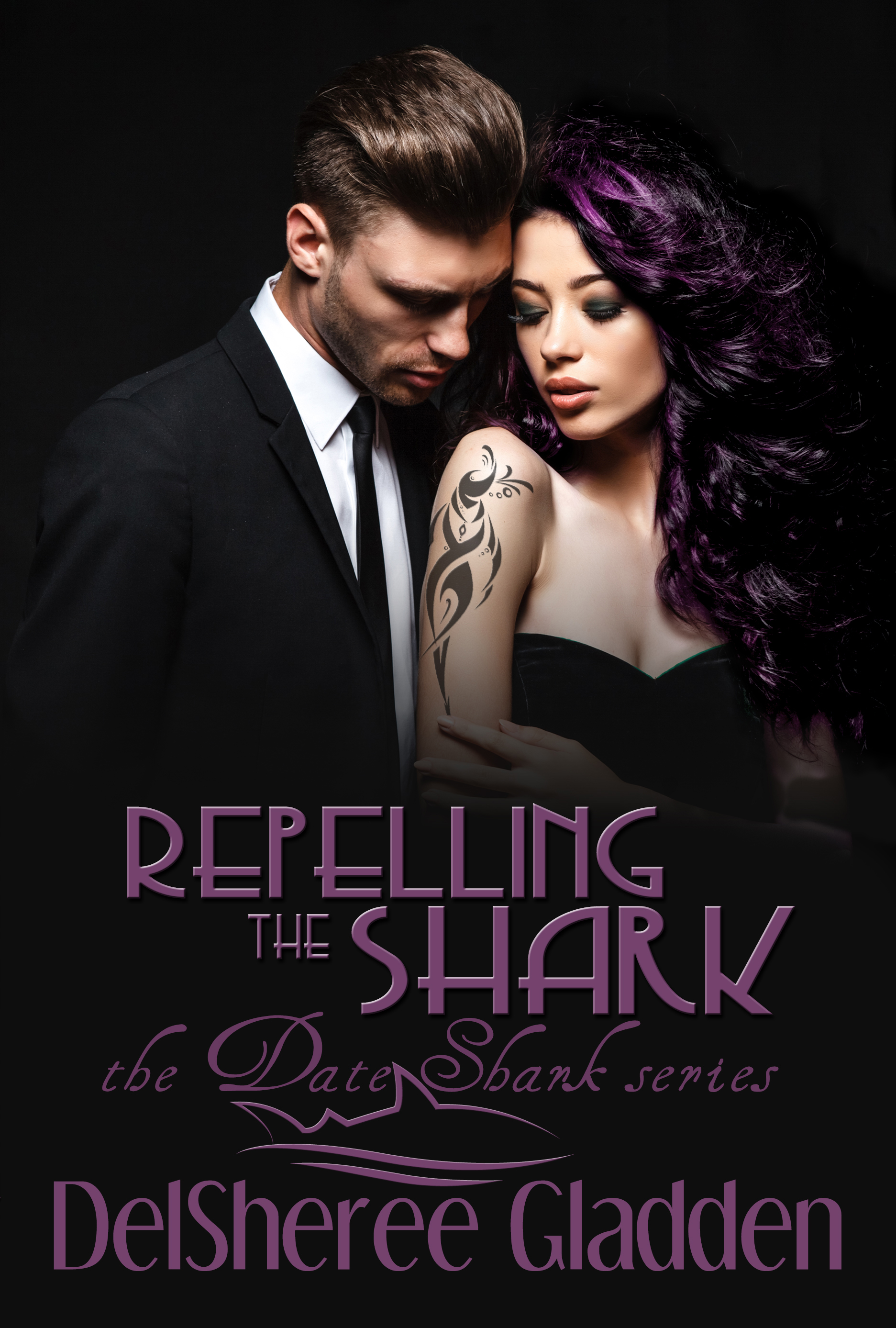
current covers for the Date Shark series that will soon be replaced as I republish the series

A little relevant history with this book: it was the first non-paranormal book I wrote and I wasn’t sure if it was any good. It was meant to be a standalone and I didn’t send it to beta readers or friends before submitting it to a publisher that was interested in my work. The publisher offered a contract and then I didn’t hear from them for months. When I asked about editing, they said it was so clean it didn’t need anything and had already been moved on to formatting. They were way wrong on that, even before I realized how off-base the characters were. Reviews frequently mentioned poor editing. Even when I got my rights back and re-edited it, the character problems were still lurking. This book really never went through a full editing process, and it clearly needed it.

I started revisions knowing I wanted to touch up the characters and relationship arc. I seriously underestimated what that would require, but having that focus has been very helpful in guiding me. If I find typos, I of course fix them, but I really like the idea of editing for something specific and not just “editing.” I’m finding that I am much more productive and zeroed in on specific goals with this style of editing. I’ll take this approach into revisions on my other books as well.

I’ll wrap up with a note about the series, which I’m sure I’ll revisit in the future as I continue working on this series. A problem with read-through on this series I noticed when analyze sales data for the last 15 years was that of my main series, this one had the lowest read-through rate. Individual books had good reviews, so this puzzled me at first. What I realize now is that across the series there is inconsistency in the spice level, the tone, and the focus of the romances.

As I work on the series as a whole, another editing goal is to improve consistency across all five books so reader get a good sense of what the series is in this first book and that is delivered across the full series. This wasn’t something I really thought about while writing them, but I’m taking a more business-minded approach to my series while still making sure the books stay true to the characters and story overall. It will be an interesting balance to strike.


Excerpt: The Stressed-Out Girl’s Handbook

Just to offer up proof to my poor readers that I have actually gotten some writing done lately, here’s the first chapter of the third book in The Handbook Series, The Stressed-Out Girl’s Handbook.


My head fell into my hands after I ended the call, thinking for the dozenth time that day that I simply couldn’t add one single more thing to my plate without my head exploding.

The resident-side door opened to the office and Sara walked in. A visit from my favorite resident and friend usually put me in a better mood. The guilty expression on her face said this would be a rare exception.

“Hey, Aspen. I need a small favor,” she began, “if you can squeeze it in tomorrow. I know you’re getting ready for classes to start Monday, and I wouldn’t ask if I had any way of getting there myself.”

I cringed internally, but Sara was the only reason I’d passed calculus last semester and I knew I would do whatever she needed of me. “Of course. What is it?”
“Monroe and I are booked all afternoon tomorrow checking out reception venues,” she began.

Frowning, I couldn’t help interrupting. “I thought you picked a place months ago.”
Sara sighed. “We did. And then a pipe burst and it flooded. The damage was pretty bad and they said there’s a chance repairs won’t be done in time, so we’re scrambling to find a new place.”

The more Sara got into planning her and Monroe’s wedding, the more I wanted to stay far away from marriage for the foreseeable future. “I’m sorry, Sara. That really sucks.”
She shrugged and shook her head. “Something was bound to go wrong. At least we still have a few months before the invitations have to go out.”

For a moment, she seemed lost in her thoughts, probably mentally running through the checklist she reviewed constantly to make sure she wasn’t overlooking something.

“So, what did you need me to do?”

Startled out of her thoughts, she chuckled. “Sorry, yeah. The photographer we booked wants to take a look at the church we’re holding the ceremony in to take some pictures and plan everything out. The only day the caretaker is available while the photographer is in town is tomorrow afternoon, of course. He won’t let the photographer wander around unescorted, and he’s too busy to do it himself.”

“What time?” I asked, trying to keep the wariness from my voice.

“Two,” Sara said in a tone that was hopeful the time wouldn’t be a major inconvenience.

I held back a sigh. “That’s totally fine.”

It wasn’t, but I would figure out how to make it work.

Sara leaned over the dividing wall and hugged me. “You’re a lifesaver!”

“No problem,” I said.

Sara didn’t catch the drop in my tone. After hurriedly giving me the address and contact info for the photographer, she rushed off to meet Monroe for some other wedding planning task. As soon as she disappeared form view, I sank into my chair.
My last weekend before the fall semester started was supposed to be relaxing. I’d even turned down invites from friends and classmates to go out and let loose a little before having to bury myself in lectures and assignments again. Ten minutes after I’d so no to a weekend of drinking and dancing, the calls, favors, and unexpected tasks had begun pouring in. I wasn’t even sure where I was supposed have time to eat at this point.

Plopping my chin onto my hand, I stared at the clock. Half and hour to go until the end of my shift. At least I would have the rest of the afternoon to catch up on cleaning and grocery shopping. I hated starting a new semester already feeling like I was behind. Sadie would be gone all weekend, thankfully. As a roommate, she wasn’t the worst, but she was far from the best either. If I didn’t get the apartment settled this weekend, it would be Christmas break before I had time to de-Sadie the place. Tidiness was not her best attribute. Neither was being quiet while endlessly playing video games.

The office phone rang and I snatched it up. The well-practiced, polite and cheerful greeting I’d perfected over the last year, spilled out of my mouth.

“Aspen,” my boss Archie said, “Cameron called in sick. I need you to stay until six.”
I balked, an absolutely not parked on my lips. I’d already covered for him twice over the past two weeks, and I had no doubt his illness was called going out to party with his friends.

“Is that a problem?” Archie prodded.

“No,” I said, deflated. “I’ll stay.”

“Great. Thanks.”

He ended the call too quickly to hear my sigh. Cameron had worked here two years longer than I had, and despite his spotty track record of showing up on weekends, holidays, or nights when he’d rather be doing something else, Archie never made a big deal about his absences. Part of that was because I had never failed to cover one of Cameron’s missed shifts, but I suspected it was also because he reminded Archie of his grandson.

The fact that I was stuck here for another five hours meant I had plenty of time to make the call knew I would need to make after Sara’s request. I stared at my phone. Texting would be easier, but pointless. She’d never see it. Even if by some miracle she did see a text from me, replying was out of the question, so I would never know whether or not it had been received.

Phone call it was.

I unlocked my phone and immediately felt like it was mocking me. My call history was still up, the number I needed to call at the top of the list, as well as the next in line, and the next, and the next. She wasn’t going to be happy. I’d already agreed to help Sara, though, and that was more time sensitive. Not that she would see it that way when I told her I would be delayed.

The number stared back at me for several more minutes as I choose my words. By the time I finally made the call, I had rehearsed both side of the upcoming conversation and dreaded it even more.

She picked up on the third ring.

“Aspen, is everything all right? You’re still coming, aren’t you?”

Weariness spread through me at her panicked tone. “I’m still coming, but I’ll be a little later than expected.”

“How late? I need you here.”

She didn’t. Not really.

“Half an hour, maybe an hour,” I said. “I’ll be there, though. I promise.”

“But…”

“You’ll be fine.”

“You don’t know that,” she argued.

I did, but saying so wouldn’t make this conversation end any quicker.

“It will be fine.”

She gulped in a worried breath. “I’d really rather you came at noon.”

“I can’t. I don’t even get off work until one. I already told you that.”

Her fear and frustration were almost audible. “I don’t like changes. You know that.”

Boy did I ever.

“I’ll be there as soon as I’m done to check in on you, okay?”

Several seconds passed in silence. “Are you sure you can’t come earlier?”

“I’m sure.”

She sighed so long and deeply that I couldn’t resist rolling my eyes. “I’ll see you tomorrow, okay?”

“Okay.” Her voice was morose, her single-word response stretched out.

I offered a quick goodbye and ended the call.

Tossing the phone down did little to ease the mounting stress. It was settling behind my eyes, promising a headache that would linger. I was tempted to lay my head down on the desk, nap and hide from any additional problems.

The office phone rang. I groaned out loud and glare at it before snatching it up.

“Manager’s office. How can I help you?”

“Um…there’s water pouring out from beneath the kitchen sink.”

New Release: Memory’s Edge 2

It’s taken me years longer (literally) than I planned to finish this book and get it published, but it’s finally available! The second part of the Memory’s Edge Duet completes the series!

Memory’s Edge Series

PART TWO

Most people only have one life-changing experience, but John and Gretchen are on round two of having their lives sent into utter chaos.

After a year of living with Gretchen after being attacked and left for dead with no memory of his former life, John’s memory returns when his wife and children find him. Leaving Gretchen weeks before their planned wedding breaks both their hearts. Being reunited with his family is a balm to that loss, but John quickly realizes the old adage that you can never go home again is even truer when you still don’t remember huge sections of your former life. A spotty memory compounds family infighting, a risk of financial ruin, and having no idea how to step back into a marriage that is complicated by his lingering love for Gretchen.

Even though Gretchen was the one to release John and step aside, going home to her friends and family and the curiosity and pity of an entire community quickly overwhelms her. Friend and neighbor Carl has been in love with Gretchen nearly since the day they met. She knows he would be more than willing to help her forget the pain of losing John, but diving into a new relationship is the last thing Gretchen needs. Feeling lost, broken, and confused leaves Gretchen floundering to figure out how to move on.

As they both face starting over, again, the pull to fall back into the familiarity of each other’s arms weighs heavily against facing the struggle to move forward.

Memorys Edge Maybes

Excerpt: Memory’s Edge Part 2

Before I move on to the next themed blog series, now that I’ve finished the Marketing Primer series, I thought I’d share an excerpt from Memory’s Edge: Part 2. This is the book I’m currently working on hoping to finish in the next month.

By the time lunch finally arrived, Gretchen was exhausted on every level. She only dragged herself out of her chair to lock the door. Before she could accomplish the task, she saw Desi sprinting down the hall and opened the door for her. Her friend crashed into her, throwing her arms around her and squeezing her hard enough to hurt.

“I am so mad at you! You know that, right?” Desi demanded when she finally pulled back. “I called and called and called!”

Yanking her friend into the classroom, Gretchen locked the door behind her and headed for her desk. Desi plopped down on top of a nearby student desk and glared at her friend. Gretchen collapsed in her seat. “I want to say I’m sorry, but I just couldn’t face talking to anyone.”

“I was so worried about you! John too! It was like I suddenly lost you both!” Her hands flew up dramatically. “How could you do that to me?”

Seeing the tears in her friend’s eyes broke Gretchen down. “I’m sorry, Desi. I know it wasn’t fair, but I just couldn’t. I still haven’t talked to my parents, either. I couldn’t even go home.”

Desi huffed. “Thank goodness Carl at least had sense enough to let everyone know you hadn’t gone off the deep end. I would have banged down your door if he hadn’t texted to say you were alive and as emotionally stable as could be expected.”

“If you had tried to bang down my door, you still wouldn’t have found me.”

Seeming a little surprised by that, Desi asked, “You’re still staying at Carl’s?”

Gretchen looked away from her friend. “Do you remember what the inside of my house looked like before we left for New York?”

Desi sighed as realization set in. “Oh, honey, I’m sorry. I hadn’t considered all the wedding prep scattered everywhere. Of course you didn’t want to go home to that.” She reached forward and squeezed Gretchen’s hand. “Have you heard from John yet?”

Looking up at her, Gretchen stared in confusion. “Why would I? He’s not coming back. He has his old life back now.”

“Yeah,” Desi said, “but what about all the wedding stuff, the catering business, his clothes and things, everything he left behind.”

Blinking away tears, Gretchen said, “It’s not like he needs any of it now, and I’ll deal with the wedding stuff eventually on my own. It’s not his problem anymore.”

Wincing, Desi asked, “So you looked him up too?”

She didn’t want to admit it, but Gretchen nodded. “I can’t even comprehend how much money he and Corey have. There’s nothing he left behind that he can’t buy again.”

“Except you.”

Gretchen glared at her friend. “It was the right choice.”

Propping her elbow on the desk, Desi dropped her chin into her palm. “I know, honey, but that doesn’t mean you can’t be hurt by his choice.”

“It was my choice as much as his. I’m the one who said goodbye and left the stage.”

“Because you knew what choice he had to make and did it for him so he didn’t have to.”

“It was the right choice,” Gretchen whispered as tears spilled down her cheeks.

Practically laying herself out across the desk, Desi ignored the fact that she was wearing a skirt and hugged her friend fiercely. “Sometimes right choices hurt worse than wrong ones.”

Gretchen clung to her friend for several long minutes before finding enough strength to pull back. “Thank you.”

She smiled and sat back up. They were quiet for a long time before Desi spoke again. “It’s going to be so weird without him here. Jake was so upset when he realized John wasn’t coming back.”

Gretchen instantly felt bad for not considering the impact of John’s leaving on anyone else in their life. Desi had gone through several boyfriends while John lived with Gretchen, but he and Jake had become very close over the last several months. Desi cared about him like a brother as well. And her parents…despite Gretchen’s mother warning her about the potential heartbreak loving John would cause, they both adored him and loved him like a son. They must have been as heartbroken over losing him as they were knowing she was hurting over the loss.

“I need to call my parents when I get home,” Gretchen said tearfully.

Desi smiled sadly. “We’re all going to miss him. I know it’s not the same for us as it is for you, but we do understand some of what you’re going through. Stay with Carl as long as you need to, but know we’re all here for you, okay? Whatever help you need to sort things out, all you have to do is call.”

Gretchen reached over the desk and hugged her again. “Thank you.”

They pulled back from each other and Desi sighed. “I better get going. I have to prep for my next class. Pottery week…” She shook her head at the impending mess and stood. “Call me later, okay?”

Gretchen nodded and watched her walk out. Another half a day to go. Then two more days until the weekend. Then one more week until spring break. She could last that long. Maybe by then she’d be ready to start putting her life back together.

The Final Date Shark Book has arrived!

Ending a series is always a tough thing for me, but I’m so excited to wrap up The Date Shark Series with Leo Bailey’s story in “Repelling the Shark!”

Repelling the Shark

the Date Shark series, book 5

Repelling the Shark

Simple and easy falls apart when secrets revealed require making promises and opening up to the possibilities of hurt and hope.

Leo Bailey has so far escaped the curse of the date shark business. He fills in when needed, but has held onto his casual relationships and family emergency-free existence. hover

Marriage and family are a vague idea for the future, but he’s not ready to give up the freedom of being single and answering only to himself.

When Piper Moretti witnesses the demise of yet another of Leo’s friends-with-benefits relationship, she doesn’t think much of it. She has a long list of more pressing responsibilities and headaches to occupy her mind.

Friends, and the strings that go with them, are at the bottom of her priority list.

When a date shark client who tops the list of bizarre behavior Leo has seen, his half-joking request for rescue drags Piper into the chaos and into Leo’s life.

Neither one wants more than a simple, no-stress friendship. Secrets and surprises force them to admit neither one is nearly as in control of their futures as they think they are.

Helping each other means getting involved, making promises, and opening themselves up to the hurt and hope they’re both terrified to face.

Creating memorable Meet-Cutes

One of my favorite meet-cutes is from You’ve Got Mail when the main characters meet Meg Ryan’s bookstore and Tom Hanks is explaining his complicated family situation. It leads so well into Meg Ryan realizing who he is and that his mega chain bookstore is going to put her out of business.

What is a Meet-Cute and how they can best be developed and utilized in romance?

The meet-cute is when a future romantic couple meets for the first time.

The purpose of a meet-cute is to set up a burgeoning relationship.

Meet-cutes often use awkwardness, embarrassment, or hostility and should hint at potential conflicts or barriers to the relationship as well as show the nature of the relationship. The meet-cute should also set the tone for the story.

Forms of meet-cutes include:

Bad first impression: sparks embarrassment, hostility, misunderstanding, etc. This provides immediate conflict, dislike, or intrigue.

The twist: gives one character the upper hand and presents a conflict.

The odd couple: presents differences that could be either complimentary or antagonistic depending on the situation.

While it’s okay to use a tried-and-true meet-cute (i.e. literally bumping into each other), it’s important to make it unique.

Try a unique location (car accident, painting class, etc.)

Have one character do something unexpected (doesn’t help the other up after a fall)

Involve a unique item (onions cascade off a grocery store display and hit the other’s foot)

Force the characters to interact in an unusual way (assigned seating at a movie separates one from a group due to buying tickets too late)

Bring them together during an emergency (fire alarm, witnessing a mugging, etc.)

For a little meet-cute inspiration for future projects, check out these real life stories!

Crafting scenes that stick with your readers

What is a scene from a book or movie that has stuck with you? Why did it connect with you? For writers, recognizing and evaluating these scenes is a great learning experience!

There are several important elements to crafting an impactful scene:

concept-1868728_1920Purpose

Every scene should have a purpose (advance the plot, reveal something about the character, or provide information about the overall plot). The purpose should be able to be condensed into a one sentence summary. Scenes with no clear purpose are filler and should be cut or rewritten.

Point of View

A scene needs to be told from the most impactful point of view. Usually this is whoever is most impacted by the events of the scene. If emotion isn’t coming through in the scene, reevaluate whose POV it’s being told from. POV is often tied to the purpose of the scene: Who will learn the most? Who will change the most? Who will react more strongly? Who has the most to lose?

The High Moment

Scenes within a story should mimic the overall story structure: beginning, middle, climax, end. The high moment uses elevated emotion, action, or revelation to impact the character(s). The high moment should come at or near the end of the scene and it should be something that produces a reaction. The high moment reveals the purpose of the scene. The character should learn something, either about his or her self or the other characters, that affects their perception or choices.

Emphasizing Conflict

Every scene needs some form of conflict: inner, outer, or both. The conflict needs to have meaning, not be pointless arguing. Conflict should get progressively worse throughout the story, increasing the stakes. Keep this in mind while planning scenes and make sure there is an overall progression. Scenes with mostly inner conflict won’t be as explosive, but should increase the overall tension.

portrait-1634421_1920

Showing Character Development and Change

Every scene should demonstrate some form of character change. The change may be subtle, but it needs to show development and growth of the character, or show backsliding behavior. Whatever happens in the scene should have an impact on the character, eliciting change on some level. Change should match the character and the event. One character may see an event as not a big deal, while the other sees it as a huge problem. They need to react and change according to their perceptions.

Staying on Point

Scenes should leave out all the boring and non-important details. Life may be filled with the mundane, but scenes should not be. If the info, actions, or dialogue doesn’t pertain to the purpose of the scene, cut it. Start in the middle of a scene, with action of some kind, and leave out the movements in and out of the scene. Only insert backstory when it doesn’t slow the present scene.

Strong Beginning and Endings

The beginning and ending should not only be strong, but should be related in some way. This may be theme, symbolism, situational, a specific action or piece of information, etc. Tie the beginning and the end together in a meaningful way that relates to the purpose of the scene.

Adding Details

Find the right balance of details to create a full scene without bogging it down. Descriptive details should be pertinent to the action, help create mood and tone, or accentuate the dialogue. Details should use all relevant senses to create a full picture of the setting, the characters, and the emotion. Details should reveal something. A clenched fist shows anger, fidgeting conveys unease, food and clothing choices set the stage and reveal preferences, etc.

Evaluating Scenes

Whether you’ve watched Dead Poet’s Society or not (if you haven’t, you should!), this scene is a powerful one: https://www.youtube.com/watch?v=j64SctPKmqk

What is one thing about this scene that sticks out to you? What impression does it leave and why?

Why chemistry between characters is key to connecting with readers

An important aspect of building story readers can connect with is developing great chemistry between characters.

149bb-istock_000019063405large

Chemistry is the emotional connection between characters, and it helps create a connection with the reader. It isn’t just about romances. All characters need to have some level of chemistry with the other characters in order to bring them to life.

Essential elements of creating chemistry include:

  1. A strong first meeting
  2. Bonding moments
  3. Conflict and dislike

Common romance chemistry tropes include:

  1. Opposites attract: provides instant conflict and a logical path of progression
  2. Forbidden love: may be true or perceived barriers; creates tension, desire, and conflict
  3. Love/Hate relationship: less realistic, but provides tension and a logical path to the climax; plays on the idea that love and hate are very similar emotions

Creating chemistry involves a balance between bonding and dislike

The balance between the two depends on the type of relationship (friends to lovers, enemies to lovers, star-crossed lovers, friends, family, estranged family or friends, etc.).

Bonding moments bring characters closer together and deepen their connection. Finding common interests, opportunities to help each other, moments of understanding, doing something unexpected for the other person, opening up about personal topics, etc.

Dislike is built with conflict (light and heavy). Competition, intellectual or moral disagreements, misunderstandings, lashing out, etc.

Bonding and dislike should escalate over the course of the story, with bonding generally having more progress (until the dark moment when dealing with main characters). Dislike will take over during crises, but a chance for bonding remains.

Creating realistic attraction develops more profound chemistry

This doesn’t mean no insta-love ever, especially if that’s going to be a source of conflict later when the character realize love at first sight doesn’t mean no problems, but the reason for their attraction should be believable.

Good looks aren’t enough. Being hot doesn’t prevent a person from being an asshole. Draw from personality, compatibility, intrigue, uniqueness…something that will last and create conflict later in the story.

Build realistic tension to increase chemistry

Tension can come in a variety of ways, including miscommunication, lies, secrets, arguments, moving too fast/slow, etc. The key is for these to be realistic and fit with the overall story. One rumor that’s never fact-checked or confronted and causes the MC to run away without looking back and fall into utter despair isn’t realistic and tends to frustrate readers. Especially if the MC is an otherwise strong and intelligent person.

If a point of tension can be fixed in less than a paragraph, it probably isn’t complex enough to be believable.

Create high stakes to build chemistry even higher

There should always be something that can completely ruin a relationship. This may be developed from page one or be a surprise two-thirds of the way through.

The risk that everything could fall apart, and both or one of the characters knows this, will affect everything they do and act as a constant reminder to the reader that they shouldn’t assume everything will turn out all right.

Movie vs. written chemistry

Working with video can have advantages over the written word, but sometimes the opposite is true. Consider how much more you can convey about a character’s internal thoughts and motivations through writing that is difficult to capture on film.

Here’s a funny example of how sharing a character’s internal thoughts on film makes for a really awkward romance scene: https://www.youtube.com/watch?v=DIlHR2SWW9E

Can you think of any other movie relationship scenes that would have been better in writing?

What exactly does “steamy” mean when it comes to romance?

When a reader says they want a “steamy” book, what does that mean? What does “sweet” or “clean” mean? Well, these often means a lot of different things to different people.

When trying to find the line between steam levels in different romance subgenres, it’s helpful to break down what each level means and which subgenres use each most often. Of course, there are books that cross, blur, or nudge the lines, but it’s good to have a firm basis to start with.

Hands Holding HeartsSweet

Low-level sexual tension, focused more on emotional elements than physical, limited to kissing and embraces. Stories often end with a proposal or strong HEA. Think G-rated movie.

Most often used in Regencies and some historicals, middle and younger YA, religious/spiritual/inspirational fiction, and sweet/clean contemporary romances.

Subtle

8a7998ee-211a-4316-9e7f-999a6df97905No explicit sensuality, kissing and touching is okay but physical descriptions are limited to general terms or are only implied. Physical acts should be focused on the emotional elements rather than explicit description. Off-screen sex is alluded to and left to the reader’s imagination. Think PG-rated movie.

Most often used in YA, mild contemporary romance, some historical romances, and spiritual/religious/inspirational.

Warm/Medium

sunset-691995_1920Moderate explicit content and sensuality. Sex is described, but not in graphic detail. The emphasis stays on the “lovemaking” and emotions, not the act. Euphemisms are more common and many details are left to the reader’s imagination. Sexual tension is used throughout, with more touching and some undressing involved, and there are usually only one or two sexual scenes in the whole book. Think PG-13 rated movie.

Common in single-title romances, upper YA, mild NA, some historicals, milder/teen paranormal/fantasy/sci-fi, and some romantic suspense/thriller/mysteries where the focus is more on the crime than the relationship.

Hot

Romantic couple in a hotel roomVery explicit sensuality and a deeper focus on sexual feelings, desire, and physical sensations. Sex scenes are longer and may have 2-3 in the book. Character thoughts are focused more on sexual urges and desires and sex is graphically described with specific body part words used and strong euphamisms. There may be light exploration of less-traditional sexual activities. The emotional aspect of sex is still important and should be balanced with the physical sensations. Sex scenes should further the story, not overtake it. Think R-rated movie.

Includes the majority of contemporary romances today, romantic suspense, most NA, some Apha/mafia subgenres, and most paranormal/fantasy/sci-fi.

Erotic

Marriage couple in the hotelExtremely explicit sensuality and descriptions with a strong focus on sexual thoughts, desires, and needs. Sex may be the primary focus of the story, but it still has a full-arc storyline and strong emotional elements. Sex often includes non-traditional elements such as light BDSM, use of sex toys, ménage or other forms of “kink.” Profanity is more common and graphic language is used in descriptions. There are usually multiple sex scenes throughout the book. These stories can’t be told adequately without the sexual content. Think NC-17-rated movies.

Erotic romance

***Always consider consent and the line between abuse and dominance. Characters must retain a choice on whether to participate and there needs to be a minimum level of respect between partners to keep it out of the realm of an abusive relationship.