An important part of choosing the right narrative mode involves choosing what narrative voice to use.
Narrative modes are individual elements used to relay a story to the reader, and include:
Dialogue, action, description, exposition, thought and scene.

Dialogue is the talk that is exchanged between characters. It is spoken communication and is punctuated with quotations. It shows personality, reveals information, and gives the reader insight about the character’s thoughts, worldview, and self-perception.
Action is events portrayed as they happen in a story. Action takes time to develop and happens in a specific place. Action is not a “report” or something that happened. It should be described “blow by blow” and not as a summary.
Description is details about how something, some place, or some person looks behaves or functions. Description should have purpose. It should develop setting, characters, situation, and time period. Description should not be self-serving or irrelevant to the situation or story. It should help orient readers in the scene.
Exposition is the telling of the story through relaying information. It is used for explaining, transitions, and narrative summary to skip details of unimportant but necessary events. Too much exposition is referring to as “telling.” Not every part of the story should be told as exposition.
Thought is character self-talk or inner dialogue. It may be only thoughts, or actual talk (self encouragement or disparagement). In third person, thought is italicized to mark it as different from dialogue. First person wording (“I”) is also used in thoughts.
Scene sets the stage for a particular part of a story. It informs the reader of the situation the story section will take place in. Special attention should be paid to the open and close of each scenes so it does not begin or extend beyond what is relevant.
Narrative Voice
Narrative voice encapsulates the writer’s and narrator’s voice, viewpoint, style, tone, mood, and how a story is presented. Voice shows personality and changes depending on the character or situation. Nearly all elements of a story contribute to the voice of the story and needs to be consciously thought out to make sure it’s present in the best way for a particular story.

Elements of Narrative Voice
Attitude has to do with emotion, values, and beliefs, worldview, and feelings about a particular person or situation. It reveals how the narrator speaks, their body language, reactions, and actions.
Tone isn’t just what is said but how something is said. Speed of speech, loudness/quietness, word choice, emotion behind words, and physical actions accompanying words all affect tone.
Personal style includes vocabulary, sentence structure, grammar/technical aspects, and personal preferences. This can be developed for each character to highlight uniqueness.
Choosing narrative modes to develop a distinct narrative voice
Every story has a unique balance of narrative modes based on which create the most appropriate feel. Modes should be varied. Stories that rely to heavily on one or a select few become monotonous.
- Vary modes used to open and close scenes
- Break up big chunks of dialogue with action
- Avoid long sections of thought
- Space out action scenes to give readers a chance to reflect and anticipate what comes next
- Keep description to what is relevant and helps develop the story, setting, or characters
 I asked this question to a group of writers I work with and got some interesting answers, from a magical beast researcher to professional occult consultant to uprooting human babies grown in soil.
 If you find you’re struggling with developing a strong backstory or aren’t sure how to incorporate the backstory elements you’ve chosen in a meaningful way, here’s a great exercise to help you delve a little deeper:
 Setting affects how a story progresses. Location can be a hindrance to or facilitate story progression. Consider how the chosen scene can be interacted with by the characters, how it might change actions or decisions, or how it affects the characters in the moment.





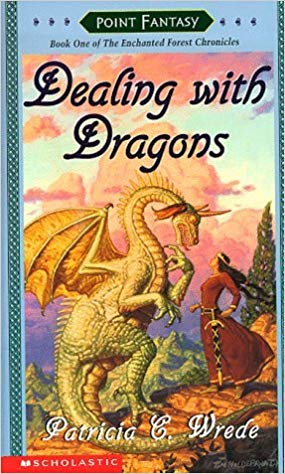 One of my favorite examples comes from one of my favorite childhood books, Princess Cimorene from “Dealing with Dragons.” She feels trapped in her life as a princess and is about to married off to a ridiculous prince, so she volunteers to be a “captive” princess for a dragon and ends up having all sorts of adventures while fending off knights who keep trying to “rescue” her.



 Writing to market also means knowing general audience expectations, likes, and dislikes. Generally, readers don’t have a strong preference for standalones or series, a plot that moves quickly and well-developed characters keeps readers from putting down a book, blurbs and book covers that don’t accurately portray a book upset readers, readers prefer to interact with authors on Facebook more than other platforms, most readers do want to interact with authors, and readers pay attention to reviews.



 Sweet
Sweet No explicit sensuality, kissing and touching is okay but physical descriptions are limited to general terms or are only implied. Physical acts should be focused on the emotional elements rather than explicit description. Off-screen sex is alluded to and left to the reader’s imagination. Think PG-rated movie.
 Moderate explicit content and sensuality. Sex is described, but not in graphic detail. The emphasis stays on the “lovemaking” and emotions, not the act. Euphemisms are more common and many details are left to the reader’s imagination. Sexual tension is used throughout, with more touching and some undressing involved, and there are usually only one or two sexual scenes in the whole book. Think PG-13 rated movie.
 Very explicit sensuality and a deeper focus on sexual feelings, desire, and physical sensations. Sex scenes are longer and may have 2-3 in the book. Character thoughts are focused more on sexual urges and desires and sex is graphically described with specific body part words used and strong euphamisms. There may be light exploration of less-traditional sexual activities. The emotional aspect of sex is still important and should be balanced with the physical sensations. Sex scenes should further the story, not overtake it. Think R-rated movie.
 Extremely explicit sensuality and descriptions with a strong focus on sexual thoughts, desires, and needs. Sex may be the primary focus of the story, but it still has a full-arc storyline and strong emotional elements. Sex often includes non-traditional elements such as light BDSM, use of sex toys, ménage or other forms of “kink.” Profanity is more common and graphic language is used in descriptions. There are usually multiple sex scenes throughout the book. These stories can’t be told adequately without the sexual content. Think NC-17-rated movies.